Erectile Dysfunction Drug Market 2026: Why Generic Sildenafil API Is the Future
The erectile dysfunction drug market 2026 is at a pivotal inflection point. A condition once spoken about only in whispers is now the subject of multi-billion-dollar pharmaceutical investment, telemedicine disruption, and one of the most compelling generic API sourcing opportunities in the global pharmaceutical industry. With over 320 million men worldwide affected by erectile dysfunction and more than 50% of men aged between 40 and 70 reporting some form of the condition the demand for effective, affordable ED treatment is structural, growing, and global.
In 2026, the global erectile dysfunction drug market is valued at approximately USD 5.17 billion, projected to reach USD 7.15 billion by 2031 at a CAGR of 6.72%. Generic Sildenafil Citrate the API that powers the world’s most prescribed ED medication sits at the absolute center of this market’s most important trend: the shift from expensive branded drugs to affordable, high-quality generic formulations manufactured predominantly by Indian pharmaceutical companies.
This blog explores the full landscape of the erectile dysfunction drug market 2026 the size, the growth drivers, the key molecules, the regional dynamics, and why generic Sildenafil API is decisively shaping the future of ED treatment worldwide.
Erectile Dysfunction Drug Market 2026: The Numbers
Multiple leading research organizations consistently confirm a market valued between USD 3.53 billion and USD 6.96 billion in 2026, depending on scope and methodology, with strong double-digit growth forecast through 2034:
| Research Firm | 2026 Market Value | Forecast Year | Forecast Value | CAGR |
|---|---|---|---|---|
| Mordor Intelligence | USD 5.17 billion | 2031 | USD 7.15 billion | 6.72% |
| Fortune Business Insights | USD 3.53 billion | 2034 | USD 7.18 billion | 9.28% |
| Market Reports World | USD 6.96 billion | 2035 | USD 10.98 billion | 6.0% |
| Grand View Research | — | 2030 | USD 4.90 billion | 9.13% |
| The Insight Partners | — | 2034 | USD 8.45 billion | 13.08% |
| Coherent Market Insights | USD 3.53 billion | 2033 | USD 5.63 billion | 6.9% |
The range of estimates reflects differences in scope — some firms include only oral PDE5 inhibitors while others encompass the full ED treatment landscape including injectables, vacuum devices, and penile implants. What is consistent across all projections is sustained growth at 6%–13% CAGR, driven by expanding patient populations, increasing treatment awareness, and the dramatic market expansion triggered by generic drug entry.
What Is Driving the Erectile Dysfunction Drug Market in 2026?
1. The Global ED Burden Is Accelerating
The scale of erectile dysfunction as a global health condition is staggering and growing. More than 320 million men worldwide are affected by ED as of 2024, with prevalence strongly linked to aging, diabetes, cardiovascular disease, obesity, and sedentary lifestyles. Over 50% of men between the ages of 40 and 70 experience some form of the condition — and approximately 65 million men globally have been prescribed sildenafil alone, with a significant portion from the United States, Europe, and Asia.
The risk factors driving ED prevalence are the same chronic conditions that are themselves growing at alarming rates globally: diabetes affects 537 million adults worldwide, cardiovascular disease is the world’s leading cause of mortality, and obesity rates continue to rise across both developed and developing markets. Each of these conditions is both a standalone cause of ED and a comorbidity that compounds severity — creating a self-reinforcing demand cycle for ED pharmaceutical treatment that has no natural ceiling in sight.
2. Generic Entry Has Transformed the Market From Niche to Mass
The single most consequential event in the history of the erectile dysfunction drug market was the expiration of Pfizer’s Viagra patent in key markets — a development that sent average tablet prices down more than 90% within just two years. The UK’s National Health Service paid GBP 31.31 per 100 mg sildenafil tablet in 2012 — by 2014, following generic entry, that price had fallen to GBP 2.53. In the US market, generic sildenafil has seen a price reduction of over 80% since 2017, transforming what was once a premium lifestyle medicine into an accessible, broadly affordable treatment option.
This price collapse did not shrink the market it dramatically expanded it. At USD 65 for a branded generic launch by Pfizer itself and as low as USD 2 per pill on digital health platforms, sildenafil transitioned from a drug purchased by affluent patients in developed markets to a medicine accessible across income levels and geographies. Generic sildenafil currently represents the largest drug type segment in the ED market, accounting for over 55% of total market share by volume. The generics segment is the leading drug type in the sildenafil drug market — and this dominance is structural, not cyclical.
3. Telemedicine Is Removing the Final Barrier to Treatment
Social stigma has historically been the single most powerful restraint on ED treatment uptake restricting approximately 35% of the target patient population from seeking medical help. Telemedicine is systematically dismantling this barrier. More than 28% of first-time ED consultations in urban North America and Europe were conducted via digital platforms in 2023 — a proportion that is accelerating rapidly.
Platforms like Hims & Hers expanded to 2.4 million subscribers and more than doubled revenue in Q1 2025 by integrating asynchronous medical evaluations with low-cost generic sildenafil. Competing services from Lemonaid Health price sildenafil at USD 2 per pill undercutting brick-and-mortar pharmacies and bringing price-sensitive patients into the market for the first time. In the US alone, over 35% of ED prescriptions were filled through online pharmacies in 2023 a channel growing at 8.89% CAGR through 2031 and expected to further accelerate as mobile health platform adoption deepens.
This digital health revolution is not replacing sildenafil API demand it is creating it at scale in demographic groups that previously went untreated.
4. Asia-Pacific Is the Fastest-Growing Regional Market
The Asia-Pacific erectile dysfunction drug market is projected to grow at a 10.04% CAGR through 2031 the fastest of any region globally. Growth is driven by an expanding patient population in India and China, rising standards of living, improving healthcare access, growing online sales of ED drugs, and increasing physician and patient awareness of ED as a treatable medical condition.
India alone records more than 10 million annual sildenafil prescriptions domestically. China issues over 12 million sildenafil prescriptions yearly. Southeast Asia home to more than 20 million ED patients contributes significantly to regional growth. The combination of a large untreated patient population, rapidly expanding internet-enabled pharmacy channels, and government-supported generic drug programs makes Asia-Pacific the most dynamic growth geography in the erectile dysfunction drug market 2026.
Why Generic Sildenafil API Is the Future of the ED Drug Market
The Dominance of Sildenafil in the ED Market
Sildenafil remains the undisputed king of the erectile dysfunction drug market. Viagra (sildenafil citrate) accounted for the largest revenue share of 57.3% in 2024 a dominance sustained not by patent exclusivity (which lapsed years ago) but by decades of prescriber familiarity, patient brand recognition, established safety and efficacy data, and the enormous generic manufacturing ecosystem that has made it globally accessible.
Over 420 pharmaceutical manufacturers worldwide now supply sildenafil in various formats. Global prescription volumes surpass 110 million units per year. Sildenafil formulations available in tablet strengths from 25 mg to 100 mg represent more than 58% of total PDE5 inhibitor prescriptions. The molecule’s dual indication both erectile dysfunction and pulmonary arterial hypertension (PAH) gives it a unique two-market demand profile that sustains volume even in segments where ED treatment awareness remains low.
The Structural Shift to Generics Is Permanent
The era of branded sildenafil dominance is over and the era of generic sildenafil volume is just beginning. Nearly 50% of global sildenafil market transactions now involve generic versions, with that proportion growing consistently as new markets open to generic ED medicines, digital pharmacy channels expand access, and price-sensitive patients in emerging markets enter treatment for the first time.
The manufacturers who dominate this generic sildenafil landscape are predominantly Indian: Aurobindo Pharma, Sun Pharmaceutical Industries, Dr. Reddy’s Laboratories, Cipla, Lupin, Torrent Pharmaceuticals, Zydus Cadila, Alembic Pharmaceuticals, and Ajanta Pharma companies that together produce a substantial portion of the world’s generic sildenafil supply. Their competitive advantage is rooted in the same factors that make India the world’s pharmacy: cost-efficient synthetic chemistry, GMP-certified manufacturing infrastructure, and regulatory expertise enabling API export to the US, EU, and emerging markets simultaneously.
Why Indian Sildenafil API Manufacturers Lead Global Supply
For pharmaceutical companies formulating generic ED tablets anywhere in the world, the sourcing question for Sildenafil Citrate API almost invariably leads to India. Here’s why:
Synthetic chemistry depth: Sildenafil Citrate is produced entirely through multi-step synthetic organic chemistry — a domain where Indian API manufacturers have world-class expertise and decades of accumulated process optimization. Indian manufacturers consistently achieve 99%+ assay purity with tightly controlled impurity profiles aligned with ICH Q3A thresholds and USP/BP/EP pharmacopoeial specifications.
Cost competitiveness: With generic sildenafil retail prices as low as USD 2 per pill, the cost of the API is a critical determinant of formulator profitability. Indian manufacturers leverage structural cost advantages lower operational costs, established synthesis routes, domestic raw material sourcing — to supply GMP-certified Sildenafil Citrate API at prices that make generic ED tablet formulation commercially viable across global markets.
GMP compliance for all markets: Leading Indian Sildenafil Citrate API manufacturers hold WHO-GMP certifications (for MENA, Africa, Southeast Asia), USFDA compliance (for US ANDA submissions), and EU-GMP credentials (for European market registrations) — enabling a single Indian API source to serve multiple regulated and semi-regulated global markets simultaneously.
Comprehensive documentation: Indian suppliers provide full regulatory documentation packages including Certificates of Analysis conforming to USP/BP/EP, ICH-compliant stability data including Zone IVb data for MENA and tropical markets, Drug Master Files for US market, and impurity profiling data — reducing regulatory submission burden for formulating companies in every target market.
ED Drug Market 2026: Key Molecule Comparison
| Molecule | Brand Name | Market Share (2024–2025) | Duration of Action | IP Status | API Source |
|---|---|---|---|---|---|
| Sildenafil Citrate | Viagra / Generic | 57.3% by volume | 4–6 hours | Off-patent globally | India dominant |
| Tadalafil | Cialis / Generic | ~30% | 36 hours | Off-patent in most markets | India, EU |
| Vardenafil | Levitra / Generic | ~8% | 4–6 hours | Off-patent | India, Europe |
| Avanafil | Stendra | ~5% | 15–30 min onset | Some markets still patented | Limited generic |
Sildenafil’s early market entry, established safety profile, lowest cost-per-dose in the generic landscape, and widest global regulatory acceptance make it the default API for generic ED formulation programs worldwide — a position it will retain through the 2030s.
The PAH Opportunity: Sildenafil’s Second Growth Engine
Beyond erectile dysfunction, Sildenafil’s approval for pulmonary arterial hypertension (PAH) — marketed under the brand name Revatio at lower doses — is creating an important secondary demand driver for Sildenafil API manufacturers. Injectable sildenafil is forecast to grow at a 9.54% CAGR through 2031 — the fastest-growing dosage form in the entire ED drug market — driven by hospital adoption of high-dose PAH protocols where oral dosing is not feasible. The 2024 label revision permitting 80 mg three times daily dosing for PAH has accelerated hospital formulary inclusion of injectable sildenafil, justifying premium reimbursement and creating a high-value incremental market for manufacturers with sterile manufacturing capabilities.
Chemox Pharma: Your Trusted Sildenafil Citrate API Supplier from India
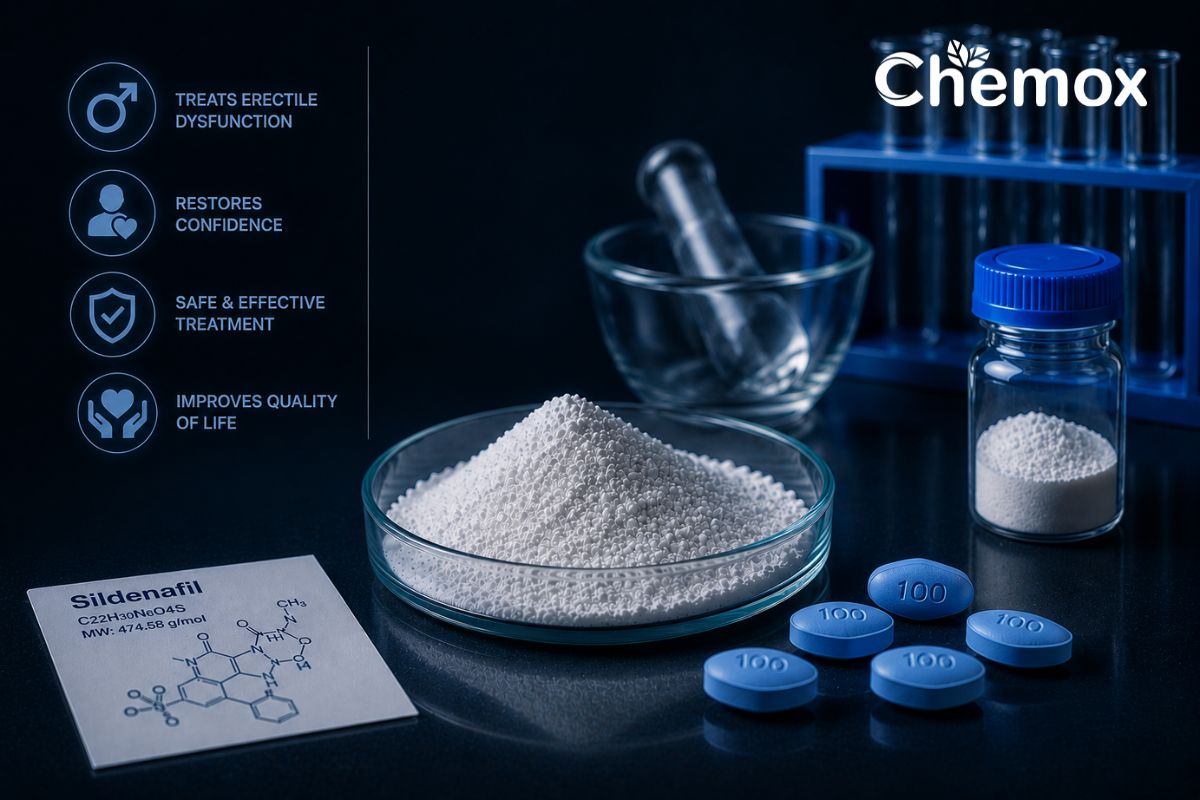
Chemox Pharma supplies Sildenafil Citrate API manufactured to USP/BP pharmacopoeial standards with WHO-GMP certification — supporting generic ED and PAH formulation programs for pharmaceutical manufacturers across MENA, Africa, Southeast Asia, and other global markets.
Our Sildenafil Citrate API is available with comprehensive Certificates of Analysis, ICH Zone IVb stability data, impurity profiles, and full regulatory documentation support for market registrations across your target geographies.