India vs China API Supply: Why Global Buyers Are Diversifying in 2026
For three decades, China built an almost unchallengeable grip on the world’s supply of generic active pharmaceutical ingredients. By 2023, Chinese manufacturers controlled approximately 80% of the global API supply chain. India despite being the world’s largest supplier of finished generic medicines imported 70–72% of its own API requirements from China, with 100% dependency on Chinese sources for 45 critical bulk drugs.
Then came 2020. Then came geopolitics. Then came tariffs.
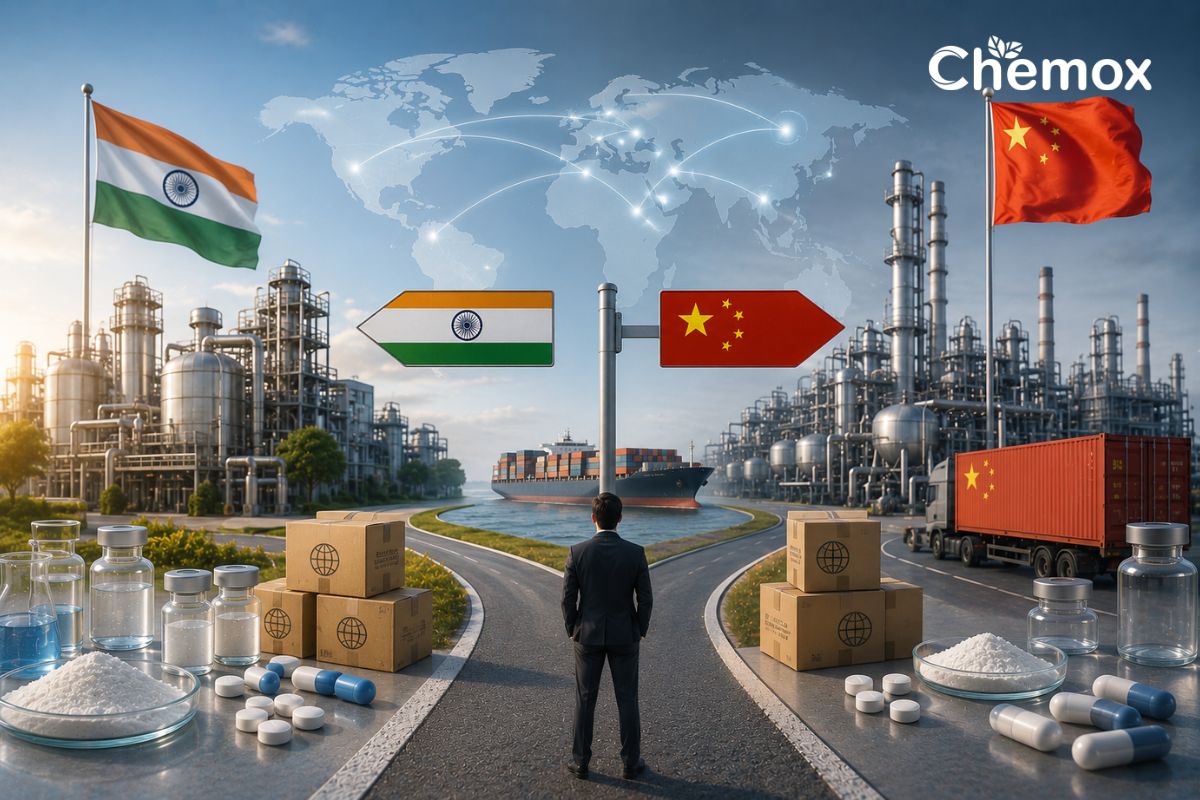
In 2026, the global India vs China API supply conversation has shifted from academic discussion to urgent procurement strategy. Pharmaceutical companies across MENA, Europe, Africa, and the Americas are actively qualifying Indian API manufacturers as primary or secondary sources not as a backup plan, but as a deliberate structural decision to build supply chains that are more resilient, better documented, and less exposed to a single geography’s political and logistical risk.
This guide covers the full picture: why China dominated, what broke the consensus, why India is emerging as the preferred alternative for global buyers, and what to look for in an Indian API manufacturer capable of supporting regulated-market supply.
How China Built an 80% Market Share in Generic APIs
Understanding the present supply chain shift requires understanding how China got to 80% market dominance in the first place. It didn’t happen overnight — it was the result of a 30-year structural advantage built on three pillars.
Pillar 1: Cost-engineered chemical manufacturing at scale
China’s petrochemical and fine chemical industry the upstream feedstock layer for pharmaceutical API synthesis is simply the largest and most cost-efficient in the world. Chinese API manufacturers benefit from domestic access to key starting materials (KSMs) at prices Indian manufacturers simply cannot match without importing from China itself. Government subsidies, cheap energy, and a fully integrated chemical supply chain allowed Chinese API producers to price finished APIs at levels that made competing domestically from India or Europe economically unviable for most molecules.
Pillar 2: Government-backed capacity investment
China’s pharma manufacturing build-out was explicitly supported by national industrial policy. Dedicated pharmaceutical parks — Wuhan, Shijiazhuang, Taizhou — provided subsidised land, utilities, and infrastructure. Companies like CJBIO, North China Pharmaceutical, and Lunan Pharmaceutical expanded to global-scale production capacities supported by state capital, allowing them to achieve unit economics that private-sector Indian or European manufacturers could not match.
Pillar 3: Price discipline through volume
Once Chinese manufacturers achieved dominant market share in key molecules Penicillin G, Ciprofloxacin, Amoxicillin, Paracetamol — they could sustain pricing discipline that made new entrants unviable. China today supplies 91% of India’s Paracetamol API, 99.6% of its Ciprofloxacin, and 95.8% of its Penicillin G. These are not marginal positions — they are near-monopolies in the world’s most essential antibiotic and analgesic molecules.
The result: by the early 2020s, a pharmaceutical company anywhere in the world sourcing a generic API was, in most cases, buying it from China directly or buying it from an Indian or European manufacturer who had sourced their KSMs from China.
What Broke the Consensus: Five Forces Driving Diversification
Force 1: COVID-19 exposed single-source dependency as an existential risk
When Chinese manufacturing hubs faced lockdowns and logistics disruptions in 2020, API supply lines froze. Prices for critical intermediates spiked. Pharmaceutical companies that had optimised their supply chains purely for cost suddenly found themselves unable to manufacture essential medicines. The pandemic did not create the fragility in global pharma supply chains — it made it impossible to ignore.
For procurement teams, the lesson was unambiguous: a supply chain where 80% of critical inputs come from one geography is not a supply chain — it is a concentrated bet. And in 2020, that bet nearly failed.
Force 2: US Section 301 tariffs on Chinese pharmaceutical goods
The United States imposed sweeping Section 301 tariffs on Chinese goods and pharmaceutical inputs were not exempt. For US generic drug manufacturers sourcing APIs from China, tariff exposure directly eroded the cost advantage that had made Chinese API pricing so attractive. The economics of China-sourced APIs began to look less compelling when landed costs included an additional 20–25% tariff burden.
In April 2026, President Trump’s proclamation further escalated the pressure imposing 100% tariffs on patented pharmaceutical imports under Section 232 of the Trade Expansion Act. Generic APIs are currently exempt from these tariffs, but the proclamation includes a one-year review clause on generics — the most consequential pending regulatory decision for the entire global API supply chain.
Force 3: China’s regulatory compliance gap in the EU and US
Regulatory quality is the second major factor — and here the gap between China and India is stark and widening.
India operates more USFDA-approved pharmaceutical manufacturing facilities than any country outside the United States. Indian manufacturers dominate global Drug Master File (DMF) filings — the prerequisite for supplying APIs into the US generic drug market. India’s WHO-GMP compliance infrastructure, CEP (Certificate of Suitability) filing capability for European markets, and regulatory documentation standards have been built over 30 years of export experience.
Chinese manufacturers, despite massive production capacity, have materially lagged on several key regulated-market requirements:
- Nitrosamine compliance: Chinese manufacturers have been slower to implement the nitrosamine impurity controls required by FDA and EMA guidance, resulting in product recalls and import alerts that damaged supplier credibility
- Data integrity standards: Multiple USFDA warning letters have cited Chinese API facilities for data integrity failures manufacturing records manipulation, falsified analytical results
- DMF filing depth: Chinese DMF packages for FDA submissions frequently lack the process chemistry depth that ANDA filers need for technically complete regulatory submissions
- CEP filings: European Pharmacopoeia CEP certifications required for regulated European markets are largely dominated by Indian and European manufacturers
For a generic drug company filing an ANDA in the US or a Marketing Authorisation in Europe, the choice between an Indian API manufacturer with a robust IH-DMF and a Chinese manufacturer without one is not a price conversation — it is a regulatory risk conversation.
Force 4: China’s price weaponisation strategy
When India’s PLI (Production Linked Incentive) scheme began subsidising domestic API manufacturing — specifically targeting molecules where India had 100% Chinese dependency — Chinese manufacturers responded with a deliberate counter-strategy: targeted price reductions of 30–33% on PLI-targeted molecules to suppress Indian investment returns and prevent competitive domestic capacity from becoming viable.
This strategy, while effective at suppressing Indian entry in some molecules, had an unintended consequence: it confirmed to global buyers that Chinese API pricing was strategic rather than cost-based. A supplier who can discount 33% on demand is a supplier whose pricing was never transparent to begin with. For procurement teams building long-term supply chain resilience, this realisation accelerated qualification of Indian alternatives — even at a modest price premium — to avoid dependence on a supplier whose pricing behaviour was explicitly designed to eliminate competition.
Force 5: Geopolitical risk becomes supply chain design input
The final force is structural: geopolitics is now explicitly embedded in pharmaceutical supply chain design in a way it simply was not a decade ago.
The US-China trade relationship has fundamentally deteriorated. EU sovereignty concerns accelerated by European chemical plant closures and renewed policy attention to medical supply security have created political pressure to reduce pharmaceutical input dependence on China. India’s status as a strategic partner for the US, EU, and Commonwealth markets makes Indian API sourcing politically as well as commercially rational for buyers in these geographies.
The “China Plus One” strategy maintaining China as the primary source but qualifying a secondary supplier elsewhere is now the stated goal of almost every Western pharmaceutical company’s procurement board. And India is, by some distance, the only country with the volumetric manufacturing capacity to be that second source at scale.
India’s Position in 2026: Strengths, Weaknesses, and the Structural Reality
Where India genuinely wins
Regulatory depth and documentation quality
India’s 30-year export track record has built a regulatory infrastructure that China simply has not matched at the same depth. Over 500 Indian pharmaceutical facilities are USFDA-approved. Indian manufacturers lead global DMF filings. CEP filings, WHO-GMP certifications, and the documentation packages required for regulated-market pharma supply are standard operating procedure at established Indian API manufacturers.
For a procurement team qualifying a new API supplier for EU or US market supply, an Indian manufacturer with an active IH-DMF, a recent WHO-GMP certificate, and experience supporting ANDA filings represents dramatically lower regulatory risk than a Chinese manufacturer without equivalent documentation.
Therapeutic breadth
India manufactures APIs across virtually every major therapeutic category — cardiovascular, antibiotic, antifungal, antihistamine, CNS, urology, oncology, anti-diabetic. Indian manufacturers have achieved multi-pharmacopoeia compliance (IP/BP/EP/USP) across hundreds of molecules. For buyers building a diversified API portfolio from a single geography, India offers the breadth that alternative sourcing geographies — Eastern Europe, Southeast Asia — cannot yet match.
English-language documentation and communication
A practical but frequently underrated advantage: Indian API manufacturers produce regulatory documentation, technical data sheets, stability reports, and business correspondence in English. For procurement teams in MENA, Africa, Europe, and the Americas, dealing with documentation in English (rather than Chinese, with translation risks for regulatory submissions) meaningfully reduces the friction in supplier qualification and regulatory filing processes.
Supply chain resilience at scale
India’s pharmaceutical manufacturing is distributed across multiple industrial clusters — Gujarat (Dahej, Ankleshwar, Vapi), Hyderabad, Maharashtra, Himachal Pradesh — rather than concentrated in a single region. This geographic distribution within India provides an internal redundancy that single-hub manufacturing geographies cannot offer.
Where India faces genuine challenges
KSM dependency on China remains structural
India’s most significant structural challenge in API manufacturing is that it imports approximately 70–72% of its own API requirements from China — and for 45 critical bulk drug molecules, that dependency is 100%. Indian API manufacturers source key starting materials (KSMs) and intermediates from China, which means the supply chain resilience argument has a fundamental limitation: disrupting Chinese KSM supply disrupts Indian API production.
The PLI scheme explicitly targets this KSM dependency — providing production-linked subsidies for domestic KSM manufacturing. Progress has been made, but the economics remain difficult for many molecules where Chinese KSM prices are subsidised below Indian domestic production cost. Buyers should understand that “India-sourced API” does not automatically mean “China-independent API” — and should ask suppliers specifically about KSM sourcing geography and domestic backward integration progress.
Price gap with China
Indian API pricing is generally 15–30% higher than Chinese pricing for equivalent molecules, reflecting India’s higher input costs (particularly for KSMs sourced from China at market rates rather than subsidised domestic rates) and the cost of maintaining regulatory compliance infrastructure. For buyers whose purchasing decisions are driven primarily by unit cost, this premium remains a genuine consideration.
However, for regulated-market buyers factoring in the full cost of supply chain risk — tariff exposure, regulatory risk, potential market recall costs, dual-sourcing program costs, documentation gap remediation — the total cost of ownership calculation increasingly favours Indian sourcing at a modest price premium over Chinese sourcing at headline cost.
Capacity scale for bulk antibiotics
For certain ultra-high-volume antibiotic APIs — Penicillin G, Amoxicillin trihydrate, Ampicillin — China’s fermentation capacity is simply larger than India’s current manufacturing capacity. Buyers requiring enormous annual volumes of these molecules may find Indian manufacturers as strong secondary sources but not yet capable of replacing Chinese supply entirely. This is a molecule-specific capacity constraint, not a general India limitation.
What the Shift Looks Like in Practice: How Procurement Teams Are Responding
The “China Plus One” strategy is being implemented in practice through several concrete approaches:
Dual qualification: Qualifying an Indian manufacturer alongside the existing Chinese source — maintaining commercial volumes with China while building a qualified alternative that can be activated if Chinese supply is disrupted. This is the most common approach for regulated-market buyers.
Regulatory primary / price secondary: Designating the Indian supplier as the primary source for regulated markets (US, EU, UK, Australia) — where regulatory documentation quality justifies the price premium — while maintaining Chinese sourcing for less-regulated markets where price is the dominant factor.
Geographic market split: Routing MENA, Africa, and South Asian market supply through Indian manufacturers (where WHO-GMP certification is the standard requirement and Indian exporters have deep experience) while sourcing separately for Chinese domestic or Asian regional markets.
KSM diversification research: The most sophisticated procurement teams are now mapping not just finished API sourcing geography but KSM sourcing geography — and specifically seeking Indian API manufacturers with domestic KSM integration or non-Chinese KSM supply chains as premium-tier dual-source qualifications.
Chemox Pharma: India’s Integrated API and CDMO Solution for Global Buyers
Chemox Pharma Private Limited represents exactly the type of Indian API manufacturer that global procurement teams are prioritising in their supply chain diversification programs in 2026.
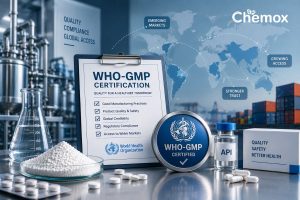
WHO-GMP certified facility at Dahej, Gujarat
Chemox Pharma’s manufacturing facility operates from the Dahej Industrial Estate, Bharuch — India’s premier pharmaceutical and chemical manufacturing corridor, with established infrastructure, robust utilities, and proximity to India’s largest port complex. The facility is WHO-GMP certified and operates under ISO 9001:2015 and ISO 14001 environmental management systems.
Multi-pharmacopoeia API portfolio across key therapeutic categories
Chemox Pharma supplies APIs across cardiovascular (Atorvastatin Calcium, Rosuvastatin Calcium), urology (Tadalafil, Sildenafil), antihistamine (Fexofenadine HCl, Cetirizine), anti-infective (Fluconazole), antibiotic (Azithromycin, Nitrofurantoin), respiratory (Montelukast Sodium), and other categories — in IP, BP, EP, and USP grades from a single GMP-qualified facility.
IH-DMF filing and full regulatory documentation package
Every commercial API manufactured by Chemox Pharma is supported by an In-House Drug Master File (IH-DMF), enabling buyers to cross-reference in ANDA and Marketing Authorisation filings. Full batch documentation — CoA, CoC, GMP certificate, CPP, stability data on request — is standard per shipment.
Export experience across 20+ countries in MENA and Africa
Chemox Pharma’s core export markets — Egypt, Saudi Arabia, UAE, Nigeria, Kenya, Jordan, and across East and West Africa — are precisely the geographies where WHO-GMP Indian API sourcing has become the procurement standard. The team’s familiarity with NAFDAC, SFDA, PPB, and GCC regulatory requirements translates directly into faster supplier qualification and smoother documentation review for international buyers.
Integrated CDMO capability for development-stage projects
Beyond commercial API supply, Chemox Pharma’s CDMO services — including custom API development, process validation, pilot plant manufacturing, analytical method development, and technology transfer — allow buyers to qualify Chemox as a partner for new molecules before bringing commercial supply online. This integrated model eliminates the supplier switching cost at commercialisation.
A Practical Supplier Qualification Checklist for Indian API Manufacturers
For procurement teams currently executing a China Plus One strategy, here is the core checklist for qualifying an Indian API manufacturer as a secondary or primary source:
Regulatory documentation:
- Active WHO-GMP certificate from a recognised competent authority (not expired)
- IH-DMF or CEP filed for the specific molecule being sourced
- Record of no current USFDA import alerts or warning letters on the facility
- ISO 9001:2015 quality management system certification
Quality evidence:
- CoA from minimum three recent commercial batches, showing consistent assay and impurity profile
- ICH Q3C-compliant residual solvents data
- ICH Q3D elemental impurities compliance
- Stability data per ICH Q1A (accelerated + long-term conditions)
Supply reliability:
- Minimum of 2 years active commercial production of the specific molecule
- Clear MOQ, lead time, and batch scheduling process
- Force majeure provisions and business continuity plan
- Confirmation of KSM sourcing — domestic vs China-sourced
Facility auditability:
- Open-door audit policy — physical and virtual audits accepted
- Internal audit schedule and most recent third-party audit report available on request
- Environmental compliance (effluent treatment, solvent disposal)
Commercial terms:
- Transparent pricing with minimum 12-month price validity
- Flexibility on packaging format and labelling requirements for export markets
- Export documentation experience for the specific destination market
Frequently Asked Questions
Q: Is Indian API truly independent of Chinese supply, or does it still depend on Chinese KSMs?
This is the most important question in the India vs China API diversification discussion, and the honest answer is: it depends on the molecule and the manufacturer. India imports 70–72% of its API KSM requirements from China. For certain molecules — particularly antibiotics like Penicillin G and Amoxicillin — Indian manufacturers are still heavily dependent on Chinese fermentation intermediates. However, for synthetic organic APIs in cardiovascular, urology, antihistamine, and anti-infective categories — Chemox Pharma’s core portfolio — the KSM dependency picture is less acute, and domestic sourcing options are more viable. Buyers should ask every Indian API supplier specifically about their KSM sourcing geography for the molecule in question.
Q: Does the current US tariff on patented pharma affect Indian generic API suppliers?
As of June 2026, the US 100% tariff imposed under the April 2026 Presidential Proclamation applies to patented pharmaceuticals and their associated APIs. Generic pharmaceuticals and biosimilars are explicitly excluded. Chemox Pharma supplies only generic APIs — so there is no direct tariff impact on current shipments. However, the proclamation includes a one-year review of generic API tariffs, which is the most consequential pending regulatory development for the Indian generic API sector.
Q: How does Indian API pricing compare to Chinese API pricing?
Indian generic API pricing is typically 15–30% higher than equivalent Chinese pricing, reflecting higher domestic KSM input costs and the cost of maintaining regulated-market compliance infrastructure. However, total cost of ownership calculations — factoring in regulatory risk, tariff exposure, dual-sourcing program costs, and documentation quality — increasingly close this gap for regulated-market buyers.
Q: Which therapeutic categories does India excel at supplying versus China?
India holds a strong competitive position in synthetic organic APIs — particularly cardiovascular (statins, antihypertensives), anti-infectives (azoles, macrolides), urology (PDE5 inhibitors), antihistamines, and CNS molecules. China holds a stronger position in bulk fermentation-derived APIs (Penicillin G, Amoxicillin, Vitamin C) and ultra-high-volume commodity intermediates.
Q: What is the “China Plus One” strategy in pharma procurement?
China Plus One refers to maintaining China as the primary API source while qualifying a secondary supplier — typically Indian — who can supply the same API to the same specification from a separately qualified GMP facility. This gives buyers supply continuity if Chinese production is disrupted (geopolitical, pandemic, logistics, regulatory) without requiring them to immediately replace Chinese volumes at a price premium.
The Bottom Line: Why 2026 Is the Inflection Point
The India vs China API supply debate is no longer theoretical. The combination of pandemic-era supply chain trauma, US tariff escalation, Chinese regulatory compliance gaps in regulated markets, China’s price weaponisation strategy, and a new geopolitical consensus around supply chain sovereignty has moved diversification from a risk committee recommendation to an active procurement program at pharmaceutical companies worldwide.
India is the only country with the manufacturing scale, regulatory infrastructure, and therapeutic breadth to absorb meaningful volumes of global API demand that is being redirected away from single-source Chinese supply. Indian manufacturers who have invested in WHO-GMP compliance, multi-pharmacopoeia capability, and regulated-market regulatory documentation are best positioned to capture this structural shift.
The question for global pharma buyers is no longer whether to diversify — it is how fast, to which suppliers, and for which molecules.
Start Your India API Sourcing Conversation with Chemox Pharma
Chemox Pharma’s business development and regulatory team works directly with pharmaceutical manufacturers across MENA, Africa, Asia, and Europe to support API supplier qualification programs — from initial documentation review and sample provision through facility audit, DMF cross-reference, and commercial supply.
To discuss your supply chain diversification requirement:
📧 Email: bd@chemoxpharma.com
📞 Call / WhatsApp: +91 9033440409 | +91 9033440407
🔗 View API Portfolio → chemoxpharma.com/api/
🔗 Request Sample or Quote → chemoxpharma.com/sample-request/