Azithromycin API Price Trend 2026: Planning Q4 Orders and Seasonal Restocking
Every autumn, the same question lands on procurement desks: should we order Azithromycin API now, or wait? The Azithromycin API price trend 2026 gives a fairly calm answer on price, since recent quarterly movement has been small, but a less calm answer on timing, because respiratory season, year-end inventory decisions, and freight all pull in different directions at the same time.
This guide covers what the 2026 price picture looks like, why Q4 behaves differently from other quarters, and how to plan your orders without overpaying or running short.
What the Azithromycin API Price Trend 2026 Looks Like So Far
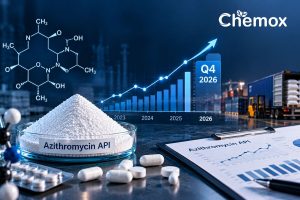
China is the world’s largest producer and exporter of Azithromycin API, which is why its price index is widely treated as a leading indicator for where global prices go over the following quarters. In 2026, price trackers have reported only modest quarter-over-quarter changes, ranging from a fraction of a percent to roughly 1.3% depending on the region and the quarter reported. Supply and demand have been described as balanced, with firmer export offers and persistent freight cost pressure explaining most of the upward drift, rather than any shortage.
Quarterly average price reports from third-party trackers have generally sat in the neighborhood of $142,000 to $144,000 per metric ton, which works out to about $142 to $144 per kg. Treat that as a market direction signal, not as a quote. Trackers measure bulk, China-origin trade, and your actual price depends on grade, documentation, volume, and terms (more on that below).
Why Q4 Brings Seasonal Restocking
Azithromycin demand follows respiratory infection season. Earlier price commentary has repeatedly linked autumn and winter prescription upticks to distributors rebuilding safety inventories, with year-end hedging adding to procurement activity. That pattern is the reason many buyers expect firmer pricing heading into Q4.
It isn’t one-directional, though. The same commentary also notes factors that pull the other way: antibiotic stewardship programs that moderate prescription growth, domestic tender pressure, and periods where ample shipments and inventory builds softened prices late in the year. A buyer who assumes prices only rise into winter can end up pre-paying for a move that doesn’t arrive.
What Actually Drives the Price
- Fermentation capacity and environmental rules. Antibiotic APIs depend on large-scale fermentation, and environmental regulation affecting fermentation output is a recurring supply-side factor.
- Export policy. Changes to API export policies in major producing countries can shift offers quickly.
- Energy costs. Energy cost volatility feeds directly into fermentation and downstream processing economics.
- Freight. Persistent freight cost pressure shows up in landed cost even when the ex-works price is flat.
- Demand shocks. Unexpected public health events that increase antibiotic consumption are the main upside risk to price and availability.
Why a Benchmark Price Isn’t Your Quote
Two buyers looking at the same market index can receive very different quotes, because the index doesn’t capture:
- Pharmacopeial grade (IP, BP, EP, USP), which affects testing scope and documentation. See our guide to API grades for how this works.
- Form and particle size. Dihydrate versus other forms, and particle size requirements for suspension formulations, can change the specification you actually need.
- Documentation package. Batch-specific CoAs, GMP certification tied to the producing facility, and any registration support all carry cost.
- Volume and MOQ. Order size changes per-kilogram economics.
- Packaging and freight terms. Incoterms and shipping method decide where cost and risk sit.
Planning Your Q4 2026 Orders
- Work backward from your production calendar. Identify when you need material in your facility, then subtract lead time and transit rather than starting from the date you’d like to order.
- Confirm lead time before price. A slightly better price that arrives after your batch is scheduled costs more than it saves.
- Decide between a single large order and staged orders. Splitting volume across two shipments reduces exposure if prices move against you in either direction.
- Lock your specification early. Confirm grade, form, and particle size before requesting quotes so every supplier is pricing the same material.
- Plan the shipping method in advance. Last-minute air freight is the fastest way to erase a good ex-works price. Our comparison of air and sea freight for API shipments covers the tradeoffs.
- Watch shelf life when building buffer stock. Extra inventory only helps if it stays within its retest period through your actual consumption window.
- Re-check the market before you commit. Quarterly moves are small, so a few weeks of delay rarely changes the price much, but it can change availability.
Azithromycin API at Chemox Pharma
Chemox Pharma manufactures Azithromycin API at our WHO-GMP certified facility in Dahej, Gujarat. Because price depends on grade, form, volume, documentation, and shipping terms, we provide current quotes directly rather than a fixed published rate. Our team can confirm availability, MOQ, and lead time for your Q4 schedule, along with the documentation your target market requires.
Request a Quote for Your Q4 Order
If you’re planning Azithromycin API purchases for the coming respiratory season, get in touch with Chemox Pharma for a quote and lead time confirmation.
FAQs
Q: Is Azithromycin API getting more expensive in 2026?
Recent price tracker reports show small quarterly increases, mostly attributed to firmer export offers and freight costs, with supply and demand described as balanced. Movements have been modest rather than sharp.
Q: Does Azithromycin API price rise every winter?
Not reliably. Respiratory season supports restocking and procurement activity, but stewardship programs, tender pressure, and inventory builds have also softened prices late in the year in some periods.
Q: Why is China’s price index followed so closely?
China is the largest producer and exporter of Azithromycin API, so its pricing is often read as a leading indicator for global direction in the following quarters.
Q: Can I use a market index price as a quote?
No. Indices reflect bulk trade benchmarks. Your price depends on grade, form, particle size, documentation, volume, packaging, and freight terms, so request a specific quote for your requirement.