Understanding Tadalafil API CoA Parameters: A Line-by-Line Guide
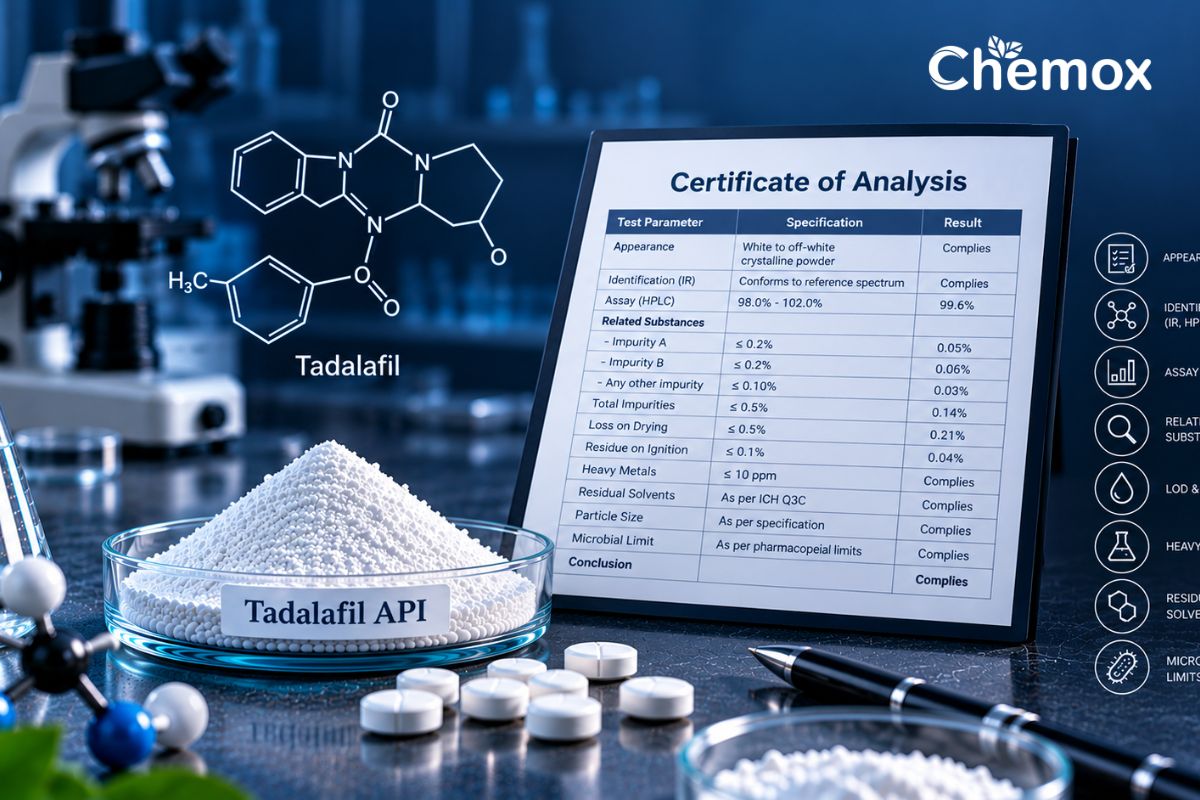
Most buyers glance at a Certificate of Analysis, check that every row says “Complies” or “Pass,” and move on. That’s understandable CoAs are dense, test-method-heavy documents — but it also means a lot of buyers never actually learn what each parameter is testing for, or why a specific result matters more than others. For an API like Tadalafil, knowing how to actually read your CoA, not just scan it, is a genuinely useful skill before you accept a batch.
This guide walks through the major parameters you’ll typically see on a Tadalafil API CoA, what each one actually checks, and why it matters.
Description / Appearance
This is the simplest parameter a visual and physical check confirming the material looks the way Tadalafil API should (typically described as a white to off-white crystalline powder). It’s a basic sanity check, but a meaningful one: a deviation in appearance can sometimes be an early indicator of a contamination or degradation issue before more sophisticated testing even runs.
Identification Tests
Identification testing (commonly via IR spectroscopy and HPLC retention time matching against a reference standard) confirms that the material is actually Tadalafil, not a structurally similar compound or an entirely different substance. This sounds obvious, but it’s one of the most fundamental checks on the entire CoA everything else on the document assumes identity has already been confirmed.
Assay (Purity)
The assay result, typically expressed as a percentage on a dry basis via HPLC, tells you how much of the batch is actually active Tadalafil versus everything else present. This result should fall within a defined acceptance range tied to the relevant pharmacopeial standard (IP, BP, EP, or USP) you’re sourcing against — and it’s worth confirming which standard the CoA is referencing, since acceptance ranges can differ slightly between pharmacopeias.
Related Substances (Impurity Profile)
This section lists individual impurities detected during HPLC analysis, each against its own specific limit, along with a total impurities limit. For a late-stage API like Tadalafil, this is one of the most important sections on the entire document it reflects how clean the synthesis and purification process actually was. A CoA that only reports “total impurities” without breaking out individual impurity results gives you meaningfully less information than one that itemizes each one.
Specific Optical Rotation
Tadalafil has defined stereochemistry, meaning its biological activity depends on having the correct spatial configuration not just the right molecular formula. Optical rotation testing confirms the material has the correct stereoisomer, which identification and assay testing alone don’t fully verify. This parameter is particularly worth checking carefully, since a stereochemistry issue wouldn’t necessarily show up as an assay or impurity failure.
Residual Solvents
Based on ICH Q3C guidelines, this section reports levels of solvents used during synthesis that may remain in the final material, each tested against its own permitted limit depending on solvent classification. Confirm the CoA lists the specific solvents relevant to the manufacturer’s actual synthesis route, not a generic boilerplate list the solvents tested should match what’s actually used in production.
Elemental Impurities / Heavy Metals
Aligned with ICH Q3D guidelines, this tests for trace metal contamination potentially from catalysts used during synthesis or from processing equipment against permitted daily exposure limits for each relevant element. This section has become more detailed industry-wide in recent years as elemental impurity guidance has tightened.
Water Content
Typically tested via Karl Fischer titration, this confirms moisture content falls within an acceptable limit. Elevated water content can affect both the material’s stability during storage and its behavior during formulation, making this more relevant than it might first appear.
Particle Size Distribution
Where specified, this parameter reports the distribution of particle sizes within the batch, often as d10/d50/d90 values. For a compound like Tadalafil, particle size can influence dissolution behavior in the finished dosage form, making this a parameter worth paying attention to if your formulation is sensitive to it.
Residue on Ignition / Sulphated Ash
This tests for inorganic residue remaining after the material is burned, serving as a general check for inorganic contamination not necessarily captured by elemental impurity testing specifically.
Batch-Specific Administrative Fields
Beyond the analytical results, a proper CoA should include the specific batch number, manufacturing date, retest date, and recommended storage conditions — tied to the exact batch you’re receiving, not a generic template document.
Red Flags to Watch For on Any CoA
- Results reported only as “Complies” without actual numeric values, where numeric results would normally be expected.
- No reference to which pharmacopeial standard or test method was used.
- Missing batch number or dates that don’t match your actual shipment.
- A total impurities figure with no breakdown of individual impurities.
- Residual solvent or elemental impurity sections that look like generic boilerplate rather than results specific to the manufacturer’s actual process.
Tadalafil API CoA Documentation at Chemox Pharma
Chemox Pharma provides batch-specific CoAs for Tadalafil API manufactured at our WHO-GMP certified facility in Dahej, Gujarat, with full numeric results across each parameter rather than a simplified pass/fail summary. If you’d like to review a sample CoA before placing an order, our team is happy to share one directly.
Request a Quote and Sample CoA
If you’re sourcing Tadalafil API and want to review a full, batch-specific CoA before you order, get in touch with Chemox Pharma for a quote and documentation review.
FAQs
Q: Why does it matter if a CoA shows individual impurity results instead of just a total?
Individual results tell you which specific impurities are present and at what level, which is more useful for assessing risk than a single combined figure — especially for impurities that might require separate regulatory justification.
Q: What does optical rotation testing confirm on a Tadalafil CoA?
It confirms the material has the correct stereochemical configuration, which is relevant to its biological activity and isn’t necessarily verified by identification or assay testing alone.
Q: Should a Tadalafil CoA specify which pharmacopeial standard it’s tested against?
Yes. Acceptance ranges for assay and other parameters can differ slightly between IP, BP, EP, and USP standards, so confirming which one your CoA references is an important part of verifying it matches your target market’s requirement.
Q: Can I request a sample CoA from Chemox Pharma before ordering?
Yes. Our team can share a sample batch-specific CoA for Tadalafil API directly so you can review our documentation format before placing an order.