Citicoline in Ophthalmic Products: What the ESCRS 2026 Study Suggests
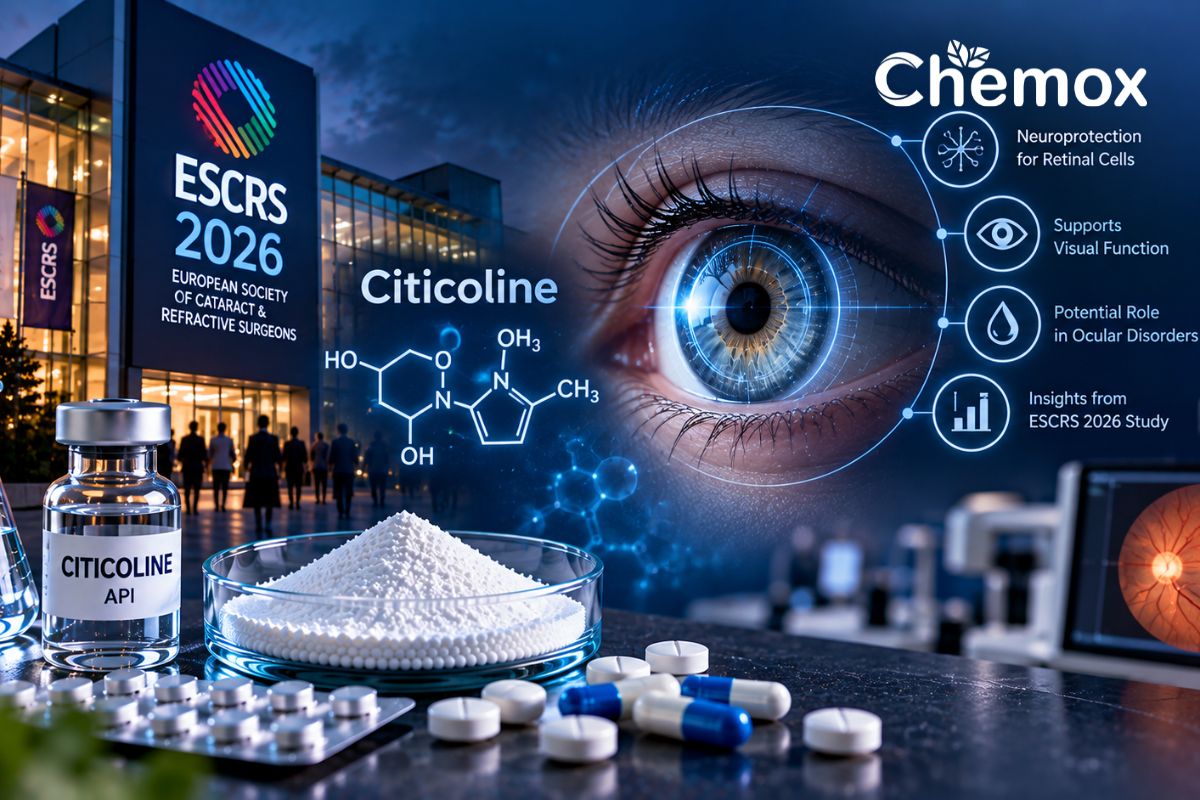
At the European Society of Cataract and Refractive Surgeons (ESCRS) congress in London in September 2026, a randomised study reported that citicoline eye drops, added to standard care, were associated with better recovery of corneal sensitivity after cataract surgery. For formulators and sourcing teams, it raises a practical question about the citicoline ophthalmic API: what does one early study mean, and what should you check before planning an ophthalmic project? This guide summarises what was reported, what it does not show, and the supplier questions that matter.
This is a plain-English summary of a conference report and a published trial, written for sourcing and development teams. It is not medical advice, and it makes no claim that citicoline treats any eye condition.
The Quick Answer
- What was reported: A prospective, randomised study presented at ESCRS 2026 found that patients who received citicoline plus standard therapy after cataract surgery had better corneal sensitivity at 3 and 6 weeks than patients on standard therapy alone.
- How strong is it? Early. The presenter herself said the sample size at later follow-up points was small and that a larger study is needed.
- What it means for API buyers: It is a signal worth watching, not a demand forecast. One study does not change regulatory status or market size.
- What matters most for ophthalmic projects: Supplier documentation, quality controls and a clear conversation about intended use, before you commit to a development plan.
What the ESCRS 2026 Study Looked At
According to the Ophthalmology Times report from the congress (held September 11–15, 2026):
| Item | Detail |
|---|---|
| Presenter | Suzana Konjevoda, MD, University of Zadar and Eye Clinic LACRIMA |
| Design | Prospective, randomised |
| Patients | People undergoing cataract surgery (phacoemulsification with intraocular lens implantation) |
| Groups | Citicoline plus standard therapy vs standard therapy alone |
| Main measure | Corneal sensitivity, measured with a Cochet-Bonnet esthesiometer before surgery and at 1, 3 and 6 weeks after |
| Secondary measures | Dry eye symptoms and tear film parameters |
| Sample size | Not stated in the report we reviewed |
What It Reported
| Time after surgery | Corneal sensitivity result |
|---|---|
| 1 week | Sensitivity fell in both groups, with no significant difference (P = .051) |
| 3 weeks | The citicoline group’s sensitivity rose while the control group’s kept declining (P = .005) |
| 6 weeks | The difference remained significant but was smaller (P = .026) |
The citicoline group also reported fewer dry eye symptoms and less ocular discomfort, and no adverse effects were reported.
What the Study Does Not Show
Read the result in context. According to the report:
- Small numbers at later follow-up. The presenter said the small sample size at later time points warrants careful interpretation.
- More data needed. She said a larger study would help confirm whether the effect is clinically meaningful, and recommended longer follow-up.
- Not a replacement for existing care. She noted citicoline would not replace current dry eye and ocular surface management, but could be an additional tool.
- Conference data. This is a conference presentation as reported by a trade publication, not a peer-reviewed paper that we have reviewed. The study used a specific branded citicoline product, so the result should not be assumed to apply to every formulation.
Citicoline and Eye Health: Other Research
Citicoline has been studied in eye health in other forms. One published example is a multicentre, randomised, double-masked, placebo-controlled cross-over trial of citicoline oral solution (500 mg once daily) in patients with open-angle glaucoma, published in Graefe’s Archive for Clinical and Experimental Ophthalmology in 2023. It enrolled 155 patients (220 had been planned). The authors reported a significant difference in a vision-related quality of life score at 6 months (p = 0.0413) but no difference in a general quality of life measure. They listed the smaller sample and high baseline scores as limitations, and the trial was funded by a company that makes a citicoline product.
The takeaway is that interest in citicoline in eye care is real, the evidence is still developing, and the study designs, doses and products differ widely. This is a reason to follow the research, not to assume a market.
What Citicoline Ophthalmic API Buyers Should Ask Suppliers
If you are evaluating citicoline for an ophthalmic project, a conversation with your API supplier should cover these points. These are general considerations, not a statement of what any particular supplier offers:
- Intended use. Tell the supplier the dosage form and route. Requirements for an eye product differ from those for an oral product.
- Specification and test methods. Ask for the full specification and the methods and standards it is tested against. For citicoline sodium, confirm which standard is used.
- Impurity and residual solvent profile. Ask for data relevant to your route of administration.
- Microbial and endotoxin controls. Ask whether any such controls or data exist for the grade you would buy, and whether they are suitable for your formulation. Do not assume an API made for oral products is suitable for ophthalmic use.
- Batch consistency. Ask for CoAs from several batches and how batch-to-batch variation is controlled.
- GMP and site evidence. Ask for facility-level certificates for the exact production site.
- Regulatory documentation. Ask what documentation support is available for your target market. Do not assume a master file exists; confirm it.
- Change control. Ask how the supplier notifies customers of changes in process, site or materials.
Chemox Pharma’s Perspective
Chemox Pharma is a WHO-GMP certified manufacturer of APIs and intermediates, with its own facility and in-house R&D centre in Dahej, Gujarat. Citicoline sodium is part of our product range. If you are exploring an ophthalmic application, please speak to our team first. We can discuss the grade and documentation available for citicoline sodium, and whether it is suitable for your intended use. We would rather confirm suitability with you early than let you assume it.
Request a Quote and Documentation
If you are evaluating citicoline sodium for development or supply, contact Chemox Pharma to discuss your requirements, available documentation and current availability.
FAQs
Q: What did the ESCRS 2026 citicoline study find?
A prospective, randomised study reported that patients who received citicoline plus standard therapy after cataract surgery had better corneal sensitivity recovery at 3 weeks (P = .005) and 6 weeks (P = .026) than those on standard therapy alone. They also reported fewer dry eye symptoms.
Q: Does this prove citicoline works for eye conditions?
No. It is an early study reported at a conference. The presenter said the sample size at later follow-up was small and that more data are needed. This post makes no treatment claims.
Q: Is citicoline approved for ophthalmic use?
Regulatory status varies by country and product, and we have not verified it for any specific market. Check the requirements of your target market and consult your regulatory team.
Q: Can any citicoline API be used in an ophthalmic product?
Not automatically. Ophthalmic products have specific quality requirements, so formulators should ask suppliers about specification, impurity profile, microbial and endotoxin controls and documentation for their route of administration. Confirm suitability with the supplier before development.
Q: Will this study increase demand for citicoline API?
It is too early to say. One conference study does not by itself change regulatory status or market size. We would treat it as a signal to watch.