
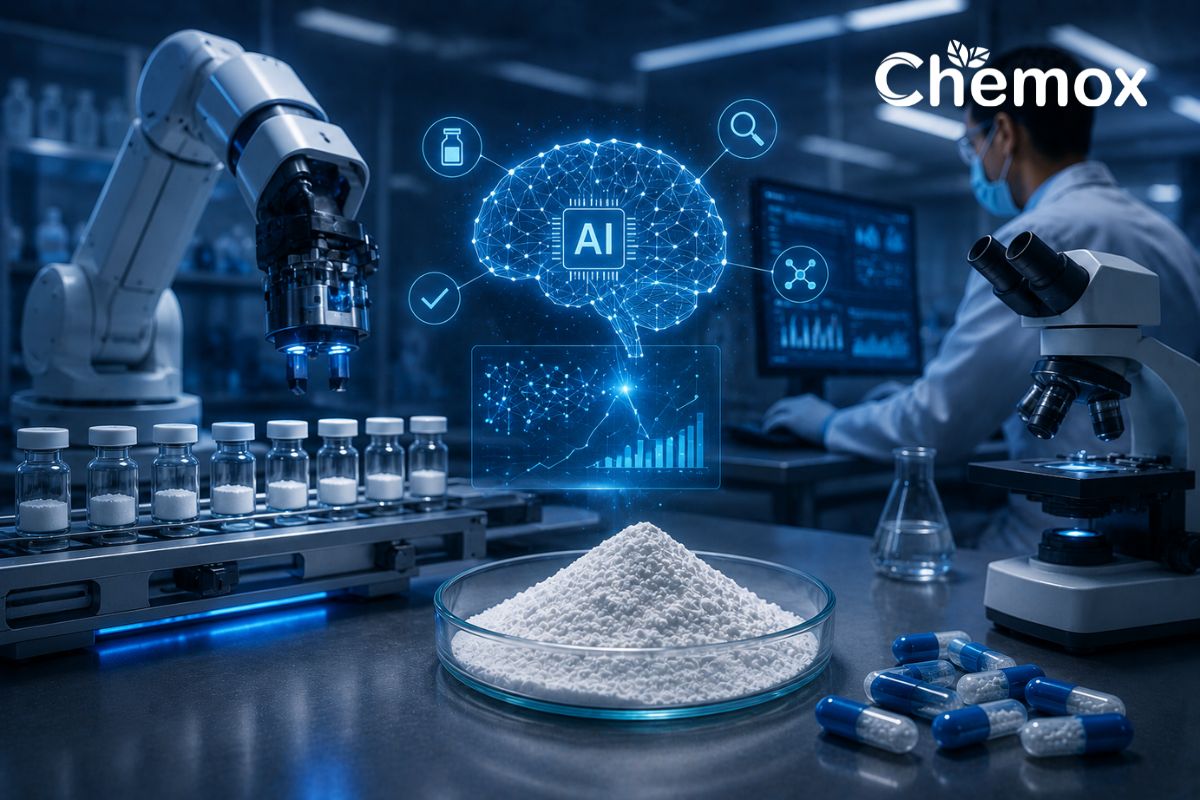
AI in API Quality Control: How Predictive Analytics Is Changing Pharmaceutical Manufacturing in 2026
Artificial intelligence has moved from pharma conference buzzword to active regulatory agenda item. In January 2026, the FDA and the European Medicines Agency jointly released the “Guiding Principles of Good AI Practice in Drug Development” ten shared principles covering the entire product lifecycle, including manufacturing and quality control. This is the clearest signal yet that AI in pharmaceutical quality systems is no longer experimental. It is becoming part of how regulators expect modern manufacturing to work.
For procurement teams and quality professionals evaluating API manufacturers, this raises a genuinely practical question: what does AI pharmaceutical quality control actually mean on a production floor in 2026, what has regulatory backing, what is still emerging, and what should you actually be asking your API supplier about their quality systems?
This guide covers the real state of AI in API manufacturing quality control grounded in current FDA, EMA, and ICH regulatory positioning, not speculative hype.
Why 2026 Is a Genuine Inflection Point for AI in Pharma Manufacturing
AI has been discussed in pharmaceutical manufacturing circles for years, but 2026 marks the point where regulatory frameworks are catching up to actual industrial adoption.
The FDA-EMA joint principles (January 2026) establish ten shared expectations for AI across the drug development and manufacturing lifecycle: human-centric design, a risk-based approach, adherence to recognised standards, clearly defined context of use, multidisciplinary expertise in model development, robust data governance and documentation, sound model design and development practices, risk-based performance assessment, life-cycle management of deployed models, and clear communication of essential information to users. This is the first time the two largest pharmaceutical regulators in the world have aligned on a single shared framework for AI a strong signal that harmonised expectations are coming, not fragmented national rules.
FDA’s CDER 2026 Guidance Agenda, issued in February 2026, explicitly lists “AI/ML Quality Considerations in Pharmaceutical Manufacturing” as a forthcoming draft guidance under the Pharmaceutical Quality/CMC category confirming that binding, manufacturing-specific AI guidance is actively in development, even though it has not yet been finalised.
The EU AI Act classifies AI systems used in quality control or process control within pharmaceutical manufacturing as “high-risk” meaning they are subject to mandatory risk assessments, human oversight requirements, and transparency obligations as EU AI Act provisions phase in through 2026.
For API manufacturers, the direction of travel is unambiguous: AI-assisted quality control is moving from an innovation differentiator to an expected component of a modern, well-governed quality management system provided it is implemented within a validated, risk-based, human-supervised framework.
What AI Actually Does in API Quality Control Today
Strip away the marketing language, and AI in pharmaceutical manufacturing today falls into a handful of concrete, well-documented applications.
Predictive Batch Failure Detection
Rather than waiting for final release testing to discover a batch has failed specification, AI models trained on historical production data can flag deviations during the process itself. A representative industry example: a pharmaceutical CMC team implementing an AI model to predict tablet dissolution failures before release, using real-time sensor data collected during production — allowing intervention before a batch reaches the point of failure rather than after.
For API synthesis specifically, this translates to models trained on reaction temperature, pressure, pH, and timing data that can flag when a batch is trending toward an out-of-specification impurity profile — while there is still time to adjust the process, rather than discovering the problem in final QC testing after the batch is complete.
Soft Sensors for Hard-to-Measure Quality Attributes
Some critical quality attributes are difficult or slow to measure directly during production — blend uniformity being a classic example. Machine learning models can infer these attributes in real time from correlated signals that are easier to measure continuously, functioning as “soft sensors” that give quality teams a continuous read on parameters that would otherwise only be confirmed through periodic offline testing.
Predictive Maintenance
AI systems analysing equipment sensor data can predict mechanical failures days or weeks in advance of breakdown — allowing planned maintenance windows instead of unplanned production stoppages. For API manufacturers running multi-step synthesis campaigns, an unplanned reactor failure mid-process can mean a lost batch, not just lost time. Predictive maintenance directly protects both production continuity and quality consistency.
Computer Vision for Visual Inspection
Computer vision systems can detect manufacturing anomalies — particulate contamination, container defects, labelling errors — with a level of consistency and sensitivity that complements human visual inspection, which is inherently subject to fatigue and variability over long inspection runs.
Advanced Process Control Combined with PAT and QbD
The most regulatory-aligned application of AI in manufacturing combines it with two established frameworks: Process Analytical Technology (PAT) and Quality by Design (QbD). Rather than treating AI as a standalone black box, this approach embeds machine learning within the existing, well-understood PAT/QbD structure — using AI for anomaly detection and advanced control while keeping the underlying process science and regulatory framework intact. This is explicitly the direction regulators are steering the industry, because it keeps AI’s role clearly scoped and auditable within frameworks inspectors already understand.
On measurable impact: industry analysis suggests predictive algorithms optimising production parameters can reduce costs by 20–30% while improving product consistency — though it’s worth noting these figures come from specific implementations and vary considerably depending on the process, the maturity of the AI model, and the quality of the underlying data it was trained on.
What AI Is Not (Yet) Doing — and Why That Matters
It’s just as important to be clear-eyed about where AI in pharmaceutical quality control is not yet operating, because overclaiming here creates real regulatory and quality risk.
AI does not replace human release decisions. Every regulatory framework in this space — FDA, EMA, ICH — is explicit that AI outputs support human decision-making; they do not autonomously make batch release or quality determinations. The FDA-EMA joint principles list “human-centric design” as the very first of their ten shared principles for a reason.
AI models require the same validation rigor as any other GMP system — arguably more. Regulatory perspectives on AI/ML implementation in GMP environments consistently emphasise a risk-based lifecycle validation approach, encompassing model development, deployment, and ongoing monitoring for “model performance drift” — the phenomenon where a model’s accuracy degrades over time as real-world data shifts away from its original training data. A model that performed well at validation can silently become less reliable months later without active, ongoing monitoring.
Existing ICH guidelines already provide the framework AI must operate within — ICH Q8(R2), Q9, Q10, and Q11 collectively establish Quality by Design and quality risk management principles that AI implementations are expected to work inside, not around. ICH Q9(R1) specifically encourages the use of advanced tools for quality risk management, giving AI-based predictive modelling an explicit, if still-developing, place within the established quality risk framework.
Full regulatory guidance specific to AI in manufacturing is still being finalised. As of mid-2026, FDA’s binding manufacturing-specific AI guidance remains in development, expected to build on the January 2026 FDA-EMA joint principles and the broader AI-in-drug-development draft guidance. Manufacturers implementing AI today are operating within existing GMP, ICH, and general AI-lifecycle-management expectations — appropriately cautiously, with strong documentation — ahead of manufacturing-specific rules being finalised.
What This Means for API Buyers Evaluating a Manufacturer’s Quality Systems
If you are qualifying an API manufacturer in 2026, AI-related quality capability is becoming a genuinely relevant — if still emerging — line of inquiry. Here is what a well-informed buyer should actually be asking, and why.
Questions worth asking
“Do you use any AI or predictive analytics tools in your quality control or process monitoring?”
This establishes the baseline. Not every manufacturer needs to be using AI today — plenty of excellent, fully GMP-compliant manufacturers rely entirely on traditional statistical process control, and that remains a completely valid, well-understood approach. The answer matters less than what follows it.
“If you use AI-assisted tools, how are they validated, and how do you monitor for performance drift over time?”
This is the question that separates a manufacturer with a genuinely governed AI implementation from one using unvalidated tools informally. A credible answer references a validation lifecycle and ongoing monitoring — not just “we use software that flags problems.”
“Does a human always make the final batch release decision, or does any part of that decision get automated?”
The correct answer, in every regulatory framework currently in force or in draft, is that a human makes the final release decision. Any manufacturer suggesting otherwise is describing a practice ahead of — and inconsistent with — current regulatory expectations.
“How does your quality system align with ICH Q9(R1) quality risk management principles?”
This question works regardless of whether the manufacturer uses AI tools at all — it’s really asking about the underlying rigor of their quality risk management framework, which is the foundation any AI tool would need to sit within to be credible.
What actually matters most
For most API buyers, the presence or absence of AI tools at a manufacturer is far less important than the underlying quality system those tools — if used — are embedded within. A manufacturer with a rigorous, well-documented, ICH Q9/Q10-aligned quality system using traditional statistical process control is a safer choice than a manufacturer using unvalidated AI tools without a governed framework around them. AI is a potential enhancement to a strong quality system — it is not a substitute for one.
Chemox Pharma’s Approach: Rigorous Fundamentals, Evaluated Technology Adoption
Chemox Pharma’s quality management system at our WHO-GMP certified facility in Dahej, Gujarat, is built on the ICH Q8–Q11 framework — Quality by Design principles, structured quality risk management, and validated process control — which is the same foundation that any credible AI-assisted quality tool must be built upon to be regulatory-sound.
We are actively evaluating predictive analytics and advanced process monitoring tools as the regulatory framework around them matures — deliberately prioritising validated, human-supervised implementations over premature adoption of tools without a clear governance framework. Our position is straightforward: we would rather implement AI-assisted quality tools correctly, once real manufacturing-specific guidance is in place, than rush deployment ahead of the framework that would make such tools genuinely trustworthy for our buyers.
In practice, this means every batch of API we release today is backed by rigorous in-process quality control, comprehensive analytical testing (HPLC, GC, ICP-MS, Karl Fischer), and full documentation aligned with ICH Q3A/Q3C/Q3D impurity and residual solvent guidelines — the same quality fundamentals that any future AI tool would need to enhance, not replace.
Frequently Asked Questions
Q: Is AI required for API manufacturing quality control in 2026?
No. As of 2026, no FDA, EMA, or ICH guidance mandates the use of AI in pharmaceutical quality control. Manufacturing-specific AI guidance from FDA is still in draft development. Traditional statistical process control and validated quality systems remain completely acceptable and widely used. AI is an emerging enhancement, not a current regulatory requirement.
Q: What is the FDA-EMA joint AI guidance released in January 2026?
The “Guiding Principles of Good AI Practice in Drug Development,” jointly released by the FDA and EMA in January 2026, establishes ten shared high-level principles for AI use across the medicine lifecycle — including human-centric design, risk-based approaches, data governance, and lifecycle management. It is a principles-level framework rather than binding, prescriptive manufacturing regulation, but it signals the direction future guidance will take.
Q: Can AI make batch release decisions in pharmaceutical manufacturing?
No. Every current regulatory framework — FDA, EMA, ICH — requires that a human makes the final batch release decision. AI tools can support this decision with predictive data and anomaly detection, but cannot autonomously make it. This is explicitly the first of the ten FDA-EMA joint AI principles issued in January 2026.
Q: What is “model performance drift” and why does it matter for pharma AI?
Model performance drift refers to an AI model’s accuracy degrading over time as real-world production data gradually diverges from the data the model was originally trained and validated on. This is a key regulatory concern because a model that performed reliably at initial validation can become less accurate months later without anyone noticing — unless the manufacturer has active, ongoing monitoring in place. Regulatory guidance increasingly expects manufacturers using AI tools to have a defined process for detecting and addressing this drift.
Q: Should I disqualify an API manufacturer that doesn’t use AI in their quality control?
No. A manufacturer’s use of AI is not, by itself, a meaningful quality indicator in 2026. What matters far more is the rigor of their underlying quality management system — ICH Q8–Q11 alignment, validated process control, comprehensive analytical testing, and robust documentation. A manufacturer with excellent traditional quality systems is a safer choice than one using unvalidated AI tools without proper governance.
Talk to Chemox Pharma About Our Quality Systems
Whether you’re evaluating our current quality management approach or want to understand how we’re thinking about emerging technology in manufacturing, our QA team is glad to walk you through our systems in detail — including a facility audit for qualified buyers.
To start the conversation:
📧 Email: bd@chemoxpharma.com
📞 Call / WhatsApp: +91 9033440407 | +91 9033440408
🔗 View our WHO-GMP Facility → chemoxpharma.com/facilities/
🔗 View API Portfolio → chemoxpharma.com/api/