
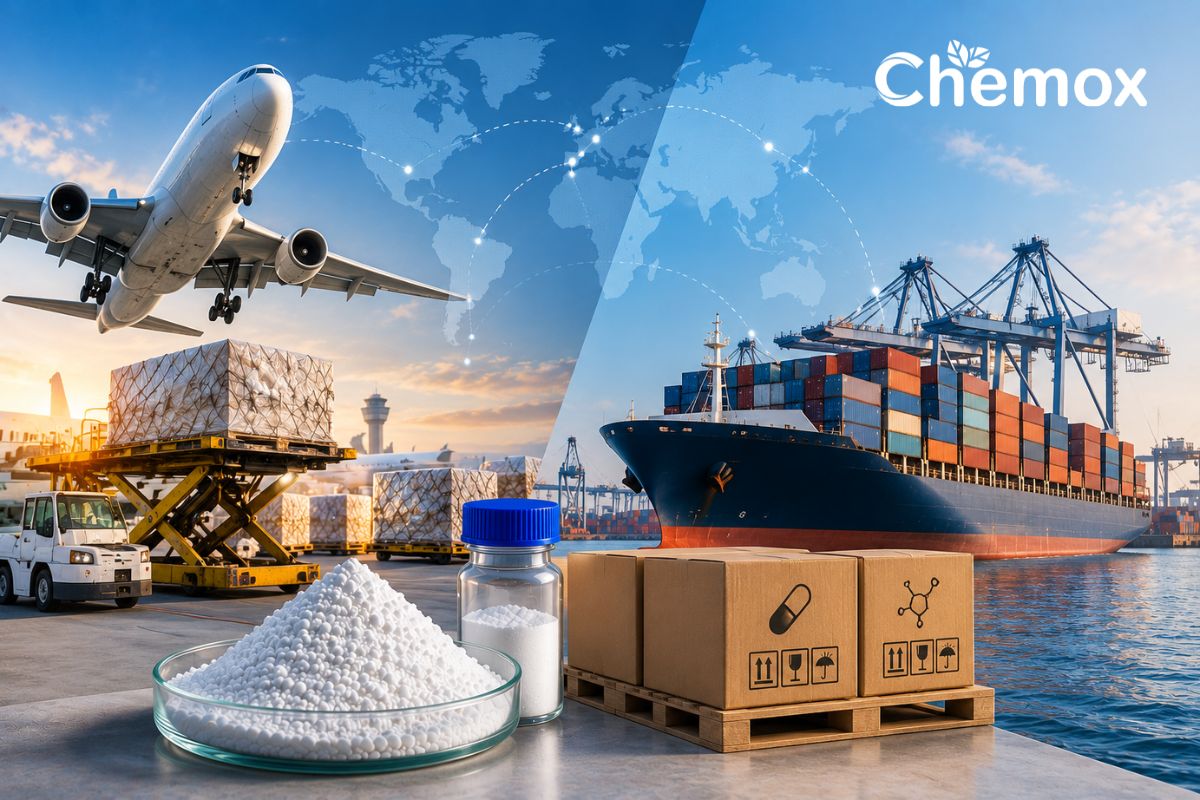
Air Freight vs Sea Freight for API Shipments: Which Should You Choose?
Once you’ve settled on a manufacturer, documentation, and pricing, there’s one more decision that often gets less attention than it deserves: how the API actually gets to you. The choice between air freight vs sea freight for API shipments affects your cost, your timeline, and depending on the molecule potentially your product’s stability by the time it arrives. Getting this decision wrong isn’t usually catastrophic, but it can mean paying far more than necessary, or building unnecessary risk into a shipment that didn’t need it.
This guide breaks down the real tradeoffs between air and sea freight for API shipments, so you can match the shipping method to your specific order rather than defaulting to habit.
Cost: The Most Obvious Tradeoff
Air freight is significantly more expensive per kilogram than sea freight often several times the cost, depending on route and current freight market conditions. Sea freight remains the more economical option by a wide margin, particularly for larger volumes where the cost-per-kg advantage compounds meaningfully across a full order.
For small orders a sample shipment or a first order at a low MOQ the absolute cost difference between air and sea freight is often small enough that speed becomes the deciding factor instead. For larger bulk orders, the cost gap becomes large enough that it usually dominates the decision unless there’s a specific reason to prioritize speed.
Speed: Days vs Weeks
Air freight typically moves an API shipment in a matter of days. Sea freight, by contrast, generally takes several weeks depending on the origin and destination ports, plus additional time for port handling and inland transport on both ends. For buyers working against a tight production or registration deadline, this difference alone can justify air freight’s higher cost a delayed shipment can cost far more in lost production time than the freight premium would have.
Stability and Transit Risk
This is the factor buyers most often overlook. Sea freight’s longer transit time means more extended exposure to temperature and humidity fluctuations, particularly during ocean crossings through varying climate zones. For APIs with known sensitivity to heat, moisture, or oxidation, this extended exposure window is a real consideration not just a theoretical one.
Before choosing sea freight for a stability-sensitive API, buyers should:
- Confirm the manufacturer’s packaging is appropriate for extended transit conditions, not just short-haul air shipment.
- Request stability data supporting the material’s specification through a transit period matching sea freight’s typical duration.
- Consider whether temperature-controlled or moisture-protected containers are necessary for the specific molecule and route.
Air freight’s shorter transit window reduces this risk simply by limiting the time the material spends exposed to uncontrolled conditions — a meaningful advantage for particularly sensitive compounds, even setting aside the cost difference.
Order Size and MOQ Considerations
Smaller orders such as an initial sample evaluation or a first bulk order at a manufacturer’s minimum order quantity are often better suited to air freight, since the total shipment cost difference versus sea freight is proportionally smaller, and the faster turnaround lets you move into formulation testing sooner. Larger, repeat bulk orders are typically where sea freight’s cost advantage becomes the clear priority, especially once a buyer has an established, ongoing supply relationship and can plan shipments further in advance.
Customs and Documentation Differences
Air freight shipments generally move through customs faster, partly due to smaller shipment volumes and more streamlined air cargo processing at many ports of entry. Sea freight shipments, particularly full or partial container loads, often involve more complex logistics coordination port scheduling, container consolidation, and inland transport arrangements which can add lead time beyond the ocean transit itself if not planned for in advance.
A Simple Decision Framework
| Factor | Favors Air Freight | Favors Sea Freight |
|---|---|---|
| Order size | Small (sample, first order) | Large bulk order |
| Timeline urgency | Tight deadline | Flexible planning window |
| Product stability sensitivity | High sensitivity, shorter exposure preferred | Stable molecule, well-documented for extended transit |
| Cost sensitivity | Lower priority than speed | Primary decision driver |
| Order frequency | One-off or infrequent | Established, recurring supply relationship |
Shipping Support at Chemox Pharma
Chemox Pharma ships API and intermediates via both air and sea freight depending on order size, destination, and buyer timeline. Our team can help you weigh the tradeoffs for your specific shipment including packaging and stability considerations for sea freight where relevant so your shipping method matches your actual requirements rather than a default assumption.
Request a Quote and Shipping Guidance
If you’re placing an order and want guidance on the right shipping method for your specific timeline and volume, get in touch with Chemox Pharma for a quote and logistics discussion.
FAQs
Q: Is air freight always faster than sea freight for API shipments?
Yes, air freight is consistently faster — typically a matter of days versus several weeks for sea freight — though it comes at a significantly higher per-kilogram cost.
Q: Does sea freight risk affecting API stability?
It can, particularly for temperature- or moisture-sensitive compounds, given sea freight’s longer transit time and exposure to varying climate conditions. Confirming appropriate packaging and stability data for the transit duration is important before choosing sea freight for sensitive materials.
Q: Which shipping method is better for a first-time sample order?
Air freight is usually preferable for sample orders and first-time low-MOQ purchases, since the cost difference versus sea freight is proportionally smaller and the faster turnaround supports quicker formulation evaluation.
Q: Can Chemox Pharma ship via both air and sea freight?
Yes. Chemox Pharma supports both shipping methods depending on order size, destination, and timeline, and can advise on the right choice for your specific shipment.