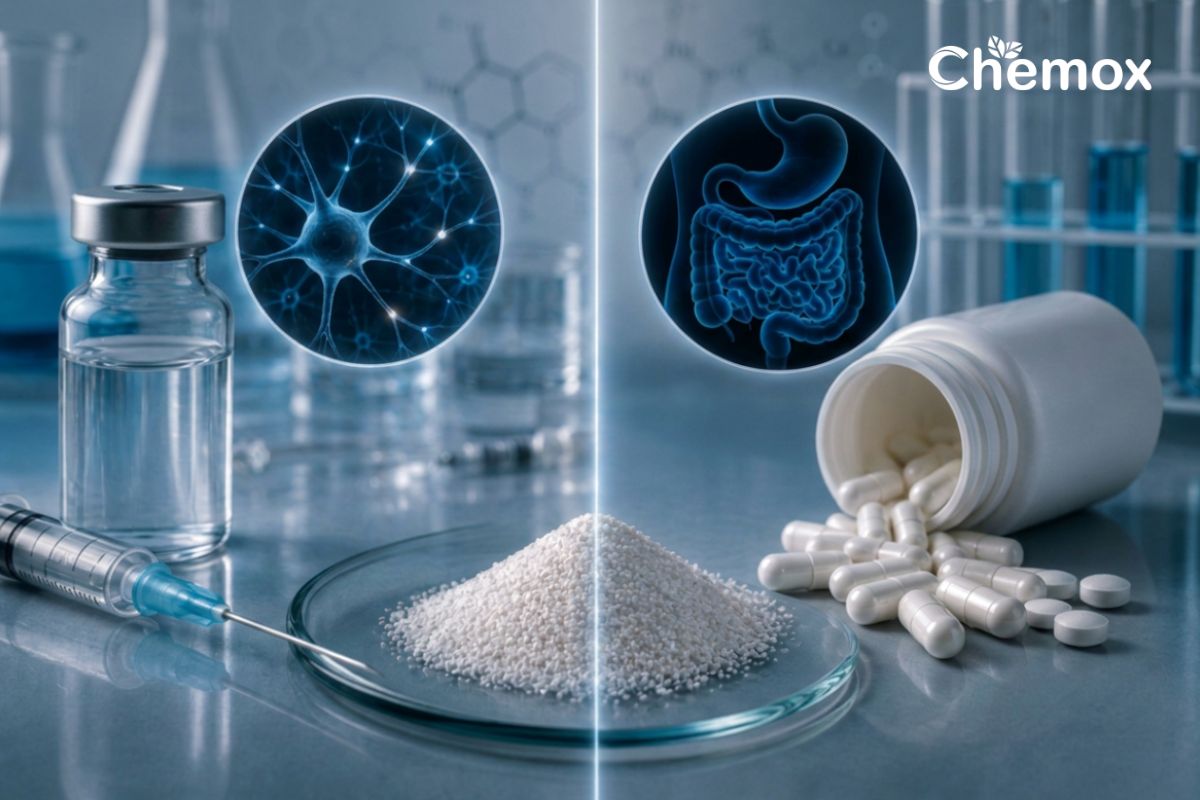
Citicoline Sodium Injectable Grade vs Oral Grade: What’s the Difference?
Not every batch of Citicoline Sodium API is built for the same dosage form. A buyer formulating an IV solution for acute stroke care has a very different specification requirement than one formulating a nootropic capsule for the supplement market — even though both start from the same base molecule. Understanding the difference between Citicoline Sodium injectable vs oral grade before you place an order prevents a mismatch that can hold up your formulation, your testing, or your regulatory submission.
This guide breaks down what actually separates the two grades, and why specifying the right one matters more than most buyers realize going in.
Why “Grade” Isn’t Just a Marketing Label
The term “grade” in API sourcing refers to the specification package the material is tested and documented against — and that package is built around how the API will ultimately be used. Injectable formulations are administered directly into the bloodstream or tissue, bypassing the body’s natural defenses against contamination that oral administration doesn’t. That single difference drives nearly every testing and documentation gap between the two grades.
Key Differences: Citicoline Sodium Injectable vs Oral Grade
Sterility and Endotoxin Testing
Injectable-grade material requires bacterial endotoxin testing (BET) and, depending on the finished formulation’s manufacturing process, sterility testing — neither of which is a standard requirement for oral-grade material. This is the single biggest differentiator between the two grades and the one buyers should confirm first.
Microbial Limits
Oral-grade Citicoline Sodium is tested against standard pharmacopoeial microbial limits appropriate for oral administration. Injectable-grade material is held to a substantially tighter bioburden standard, since any microbial contamination poses a direct systemic risk when administered parenterally.
Particle Size and Solubility
Injectable formulations — particularly those requiring reconstitution or direct IV administration — depend on complete, rapid solubility. This often means injectable-grade material needs tighter control over particle size distribution than oral-grade material, where slower dissolution in the GI tract is less critical.
Heavy Metals and Elemental Impurities
Both grades are tested against ICH Q3D elemental impurity guidelines, but injectable-grade specifications frequently apply stricter permitted daily exposure (PDE) limits, since the parenteral route delivers 100% of the dose systemically without first-pass metabolism.
Packaging and Handling
Injectable-grade API typically requires packaging and handling under more controlled environmental conditions to minimize particulate and microbial contamination risk between manufacturing and final formulation — an added layer oral-grade material doesn’t require.
Documentation Package
Buyers formulating an injectable product should expect (and request) a more extensive documentation package, including detailed impurity profiles, endotoxin test results, and — depending on the destination market’s regulatory requirements — additional validation data supporting the material’s suitability for parenteral use.
A Quick Comparison
| Parameter | Oral Grade | Injectable Grade |
|---|---|---|
| Bacterial endotoxin testing | Not required | Required |
| Microbial limits | Standard pharmacopoeial limits | Significantly tighter |
| Particle size control | Standard | Tighter, application-dependent |
| Elemental impurity limits | ICH Q3D standard | Often stricter PDE limits |
| Typical dosage forms | Tablets, capsules, powders, oral solutions | IV/IM injectable solutions |
Why This Matters Before You Place an Order
Ordering oral-grade material for an injectable formulation isn’t just a quality mismatch — it can mean your product fails testing at the finished-dosage stage, or worse, that a regulatory reviewer flags inadequate API documentation during your submission. On the other side, requesting injectable-grade specifications for an oral product usually means paying for testing and documentation depth your formulation doesn’t actually need.
Questions to Ask Your Supplier
- Does your Citicoline Sodium API undergo bacterial endotoxin testing, or only standard microbial limit testing?
- What elemental impurity limits does your specification apply — standard ICH Q3D or tighter injectable-specific limits?
- Can you provide documentation specific to the grade my formulation requires?
- Is your quoted material tested and packaged to the specification my dosage form actually needs?
Sourcing the Right Grade From Chemox Pharma
Chemox Pharma is a WHO-GMP Certified Citicoline Sodium API Manufacturer, supplying high-quality pharmaceutical-grade Citicoline Sodium API to customers worldwide. Whether you’re formulating an oral supplement or an injectable clinical product, our team can confirm which specification and documentation package fits your intended dosage form before you finalize your order so you’re not guessing which grade you actually need.
Request a Quote for Your Specific Grade
If you’re sourcing Citicoline Sodium API and need to confirm which grade — oral or injectable — fits your formulation, get in touch with Chemox Pharma for a quote and sample evaluation.
FAQs
Q: Can the same Citicoline Sodium batch be used for both oral and injectable formulations? Not typically. Injectable formulations require additional testing — particularly bacterial endotoxin testing and tighter microbial limits — that oral-grade batches aren’t necessarily tested against.
Q: What’s the most important test that separates injectable grade from oral grade? Bacterial endotoxin testing (BET) is the clearest differentiator — it’s a standard requirement for injectable-grade material and not typically required for oral-grade material.
Q: Does injectable-grade Citicoline Sodium cost more than oral grade? Injectable-grade material generally involves more extensive testing and tighter specifications, which can affect pricing. Confirm current pricing for your specific grade and volume directly with your supplier.
Q: Should I specify which grade I need when requesting a quote? Yes — always confirm whether your formulation is oral or injectable when requesting a quote, so the supplier provides material tested to the correct specification.