India Targets $120 Billion Pharma Industry as Exports and Innovation Drive Growth
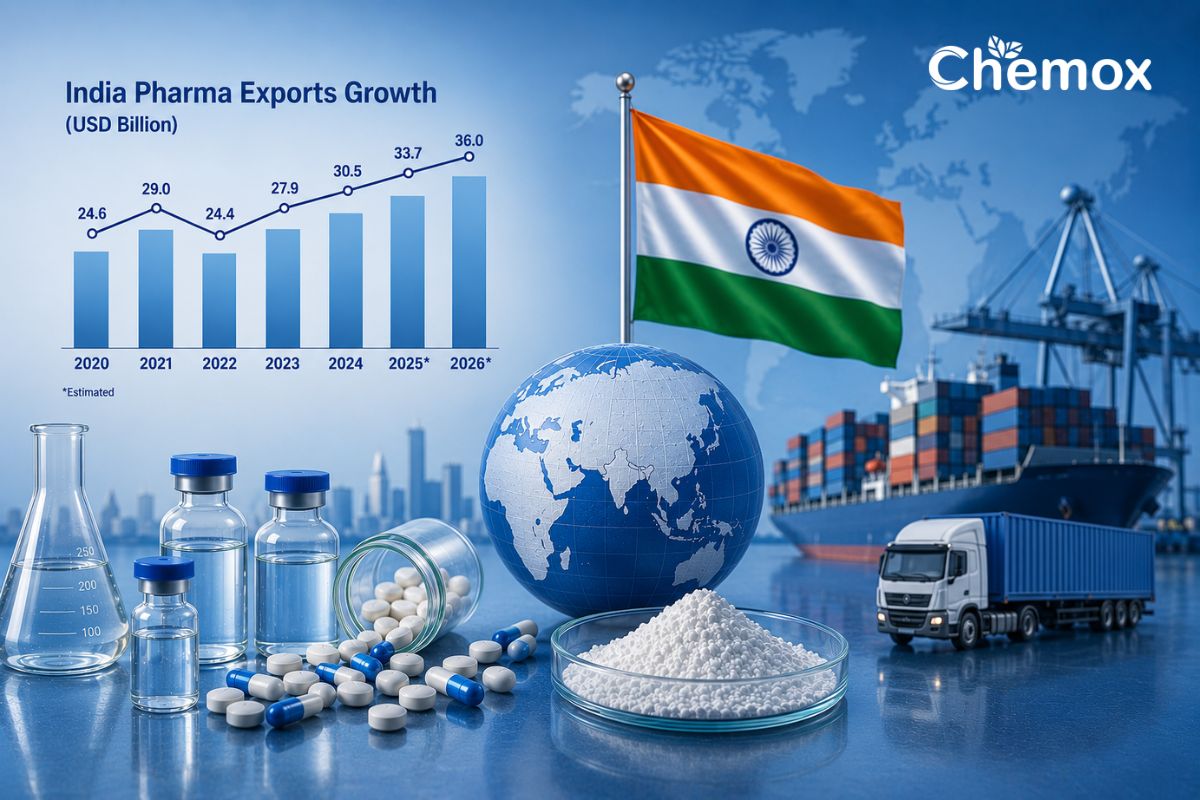
India’s Commerce and Industry Minister Piyush Goyal said the India pharma industry $120 billion target is well within reach the sector, currently valued at approximately $60 billion, has the potential to double within the next five years
This isn’t a vague aspiration. Goyal grounded the claim in three specific pillars — trust, innovation, and partnership each backed by concrete data points about India’s current manufacturing position, regulatory standing, and growth trajectory. For global pharmaceutical buyers, procurement teams, and API sourcing professionals, this announcement is worth understanding in detail: it signals where India’s pharmaceutical manufacturing capacity, investment, and strategic priorities are heading over the next five years directly shaping the sourcing landscape for anyone buying APIs or finished formulations from Indian manufacturers.
What Goyal Actually Said
Speaking on June 8, 2026, Goyal framed India’s pharmaceutical growth story around three specific pillars:
Pillar 1: Trust
India’s manufacturing credibility rests on hard, verifiable numbers. Goyal noted that India has aligned its Good Manufacturing Practices framework with global benchmarks, and pointed to several specific facts: India supplies approximately 65–70% of the World Health Organization’s total vaccine requirements, hosts the highest number of USFDA-approved pharmaceutical manufacturing plants outside the United States, and is home to 10 of the world’s 25 largest generic pharmaceutical companies. He also highlighted that generic medicines account for 80–90% of the volume of medicines sold in the United States by volume though notably only about 10–15% of the value —underscoring both India’s manufacturing scale and the affordability advantage Indian generics provide globally.
Pillar 2: Innovation
Goyal was explicit that India is not abandoning its generic manufacturing strength, but is deliberately building innovation capacity alongside it. He cited that India’s patent filings have nearly doubled in recent years, reflecting a genuine and measurable increase in domestic research activity. He also referenced the Biopharma SHAKTI programme a government initiative launched to promote pharmaceutical innovation alongside a broader $10 billion government programme supporting innovation across sectors, including pharmaceuticals and biotechnology.
Pillar 3: Partnership
Goyal directly invited global pharmaceutical companies to deepen their presence in India, pointing to the scale of the opportunity: a domestic market of over 1.4 billion people, rising incomes, an expanding middle class, and continued strong GDP growth (7.7% at constant prices for the year ended March 2026, notably achieved despite 50% US tariffs and ongoing geopolitical conflicts). He also emphasised India’s expanding free trade agreement network covering more than 50 countries, including nine FTAs signed over the past 12 years — which has secured preferential, and in many cases zero-duty, market access for Indian pharmaceutical exports in a significant share of global markets.
Why This Announcement Matters Beyond the Headline Number
It would be easy to read “India pharma industry $120 billion” as standard political optimism at a trade event. But several specific elements of Goyal’s framing are worth taking seriously as genuine signals for the industry’s direction.
India is deliberately moving up the value chain without abandoning generics
One of the more nuanced points in Goyal’s remarks is that India is “steadily progressing beyond its traditional strength in generic medicines towards innovation-driven pharmaceutical products, while continuing its commitment to providing affordable healthcare solutions across the world.” This is a meaningfully different growth strategy than simply scaling existing generic manufacturing volume — it points toward increasing investment in complex generics, biosimilars, novel drug development, and higher-value manufacturing capability, alongside (not instead of) India’s core generic API and formulation strength.
For API buyers, this suggests the Indian manufacturing base you rely on today for generic APIs is likely to become more sophisticated over time — not replaced, but layered with additional capability in areas like complex generics, biologics-adjacent manufacturing, and innovation-linked production.
The trust pillar is a direct answer to supply chain diversification conversations
Every statistic Goyal cited under the “trust” pillar — WHO vaccine sourcing share, USFDA facility count, global generic company presence — is directly relevant to the broader “China Plus One” and supply chain resilience conversation that has shaped global pharma procurement strategy over the past several years. This wasn’t incidental; it’s a clear signal that the Indian government understands its strategic position in global supply chain diversification and is actively messaging to reinforce it at the highest level.
FTA-driven market access is quietly one of the most consequential parts of this story
Goyal’s point about India having secured preferential or zero-duty market access for pharmaceutical products across more than 50 countries through free trade agreements is easy to skim past, but it has real, practical implications for cost competitiveness. For buyers in FTA-partner countries, Indian API and formulation exports may already carry duty advantages that aren’t always factored into landed cost comparisons against alternative sourcing geographies.
The growth target implies substantial capacity investment is coming
Doubling a $60 billion industry to $120 billion in five years — even accounting for value growth from innovation-linked products rather than pure volume — implies significant new manufacturing capacity, R&D infrastructure, and export logistics investment across the Indian pharmaceutical sector over the coming years. For buyers building multi-year sourcing relationships with Indian manufacturers, this points toward a growing, increasingly capable supplier base — a genuinely positive signal for long-term supply chain planning, provided that growth translates into broader manufacturer capability rather than being concentrated only among India’s largest existing players.
What This Means for API Buyers Specifically
Expect continued government investment in quality and compliance infrastructure
Goyal’s repeated emphasis on GMP alignment with global standards and USFDA facility density is not just messaging — it reflects continued government-level investment in the regulatory and quality infrastructure that underpins India’s export credibility. Buyers should expect this trend to continue: more Indian facilities pursuing and maintaining USFDA, WHO-GMP, and EU-GMP certification as the government pushes toward its stated growth target.
The innovation push may create new categories of Indian API supply over time
As India’s patent filing activity grows and government-backed innovation programmes like Biopharma SHAKTI mature, buyers may see a gradually expanding range of complex, novel, and higher-value API categories becoming available from Indian manufacturers — beyond the traditional small-molecule generic strength the industry has built its reputation on. This is a multi-year trend rather than an immediate shift, but worth factoring into long-term category sourcing strategy.
FTA market access is worth actively checking against your own country
If your company sources APIs or finished formulations from India and operates in a country with a bilateral or regional FTA with India, it’s worth directly confirming whether your specific product category benefits from preferential or zero-duty access — this can represent a meaningful, underappreciated cost advantage that doesn’t always surface in standard supplier price comparisons.
This reinforces India’s position, but doesn’t eliminate the value of supplier-level diligence
A strong national growth trajectory and government backing are genuinely positive signals for India as a sourcing geography overall — but they don’t substitute for direct, supplier-specific due diligence. The quality, documentation rigor, and reliability of any individual API manufacturer still needs to be verified directly, regardless of the broader industry’s growth story.
Chemox Pharma’s Perspective: Part of a Growing, Ambitious Industry
Chemox Pharma Private Limited operates as a WHO-GMP certified API manufacturer within exactly the ecosystem Minister Goyal described — a sector built on manufacturing trust, growing steadily more innovation-oriented, and increasingly positioned as a long-term global partner rather than simply a low-cost generic supplier.
As India’s pharmaceutical industry pursues this next phase of growth, our own focus remains consistent: maintaining rigorous WHO-GMP compliance, building genuine process chemistry and CDMO development capability, and serving our export markets across MENA, Africa, and Asia with the documentation quality and reliability that regulated-market buyers require. Whether or not the $120 billion target is reached precisely on this five-year timeline, the underlying direction — more investment, more capability, more global partnership — is one we see reflected directly in our own growth plans.
Frequently Asked Questions
Q: What did Piyush Goyal actually announce about India’s pharma industry? Speaking at the Global Ambassador Meet on the Pharmaceutical Sector alongside IPHEX 2026 in New Delhi (June 8, 2026), Commerce and Industry Minister Piyush Goyal stated that India’s pharmaceutical industry, currently valued at approximately $60 billion, has the potential to double to $120 billion within the next five years — driven by trust in India’s manufacturing standards, growing innovation and patent activity, and expanding international partnerships.
Q: Is India moving away from generic drug manufacturing? No. Goyal was explicit that India intends to continue its role as a major global supplier of affordable generic medicines while simultaneously building innovation-driven, higher-value pharmaceutical capability alongside it. The strategy is additive — building new capability — rather than a shift away from India’s core generic manufacturing strength.
Q: What is the Biopharma SHAKTI programme mentioned in this announcement? Biopharma SHAKTI is a government initiative referenced by Goyal as part of India’s innovation push, announced with a ₹10,000 crore (approximately $1.1 billion) outlay in the February 2026 Union Budget, aimed at supporting biologics, biosimilars, and pharmaceutical R&D infrastructure, including plans for an expanded clinical trial site network.
Q: How does this growth target affect API buyers sourcing from India? It signals continued government-level investment in manufacturing capacity, quality infrastructure, and regulatory compliance across India’s pharmaceutical sector — generally positive for long-term supply chain planning. However, buyers should continue to conduct supplier-specific due diligence, since broader industry growth doesn’t substitute for verifying the quality and reliability of an individual manufacturer.
Q: What percentage of US generic medicines come from India? According to Goyal’s remarks, generic medicines account for 80–90% of the volume of medicines sold in the United States, and a substantial share of that generic supply is sourced from Indian manufacturers — though by value, generics represent only about 10–15% of the US pharmaceutical market, reflecting their affordability relative to branded and innovator products.
Source a WHO-GMP Certified API Manufacturer Growing With the Industry
Chemox Pharma is proud to be part of India’s growing pharmaceutical manufacturing base. Whether you’re sourcing established generic APIs or exploring a longer-term supply partnership, our team is glad to discuss how we fit into your procurement strategy.
To start the conversation:
📧 Email: bd@chemoxpharma.com
📞 Call / WhatsApp: +91 9033440409 | +91 9033440410
🔗 View API Portfolio → chemoxpharma.com/api/