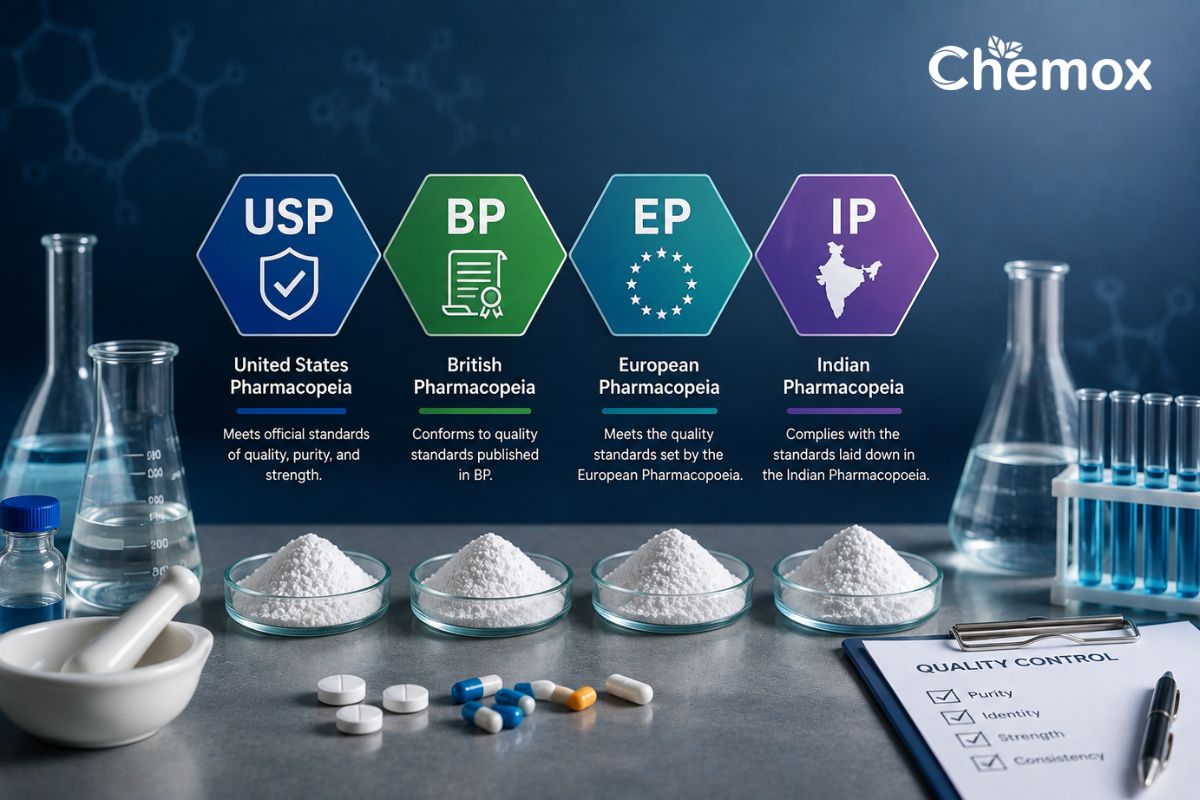
Understanding API Grades: USP vs BP vs EP vs IP, Explained
If you’ve spent any time sourcing active pharmaceutical ingredients, you’ve seen the same four letter combinations show up again and again on spec sheets and pricing pages: USP, BP, EP, and IP. Most buyers know these are “grades,” but far fewer can confidently explain what actually differs between them — or which one their own product registration actually requires. Getting this wrong doesn’t just mean paying for more testing than you need; it can mean your dossier gets rejected for referencing the wrong pharmacopeial standard entirely.
This guide breaks down API grades: USP, BP, EP, and IP, explained simply what each one is, where it applies, and how to decide which grade fits your formulation before you place your next order.
What Is a Pharmacopeia, and Why Does It Matter?
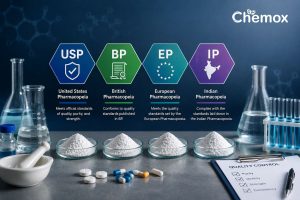
A pharmacopeia is an officially recognized compendium of quality standards for pharmaceutical substances covering identity tests, purity limits, assay methods, and permissible impurity levels for a given API. When a supplier says their material is “USP grade” or “EP grade,” they’re saying the material has been tested against that specific compendium’s defined specifications, using that compendium’s defined test methods.
The underlying molecule is usually the same across all four grades. What differs is the specific testing standard it’s certified against and by extension, which regulatory markets will readily accept that documentation.
The Four Major Pharmacopeial Standards
USP — United States Pharmacopeia
USP grade is the standard most closely associated with the US market and FDA-regulated submissions. If you’re formulating a product intended for US registration, or working with a US-based buyer, USP-compliant documentation is typically the baseline expectation.
BP — British Pharmacopoeia
BP grade aligns with UK and several Commonwealth-market regulatory expectations. It’s widely recognized across a number of export markets beyond the UK itself, particularly where British regulatory influence has historically shaped local pharmacopeial standards.
EP — European Pharmacopoeia
EP grade is the standard recognized across the European Union and is frequently referenced in registration dossiers for EU member states. For buyers targeting European markets — or any market that aligns its requirements with EU standards — EP-compliant documentation is generally expected.
IP — Indian Pharmacopoeia
IP grade reflects India’s own national pharmacopeial standard, commonly used for domestic Indian formulation and in a number of semi-regulated export markets that accept Indian Pharmacopoeia-referenced documentation. IP grade is often the most cost-effective option where the target market doesn’t specifically require USP, BP, or EP compliance.
How These Grades Actually Differ
The differences between grades typically come down to a few specific areas rather than a wholesale difference in the substance itself:
- Test methods — the exact analytical procedures used to confirm identity and purity can vary between pharmacopeias.
- Impurity limits — permitted levels of related substances and residual solvents can differ, sometimes meaningfully, between standards.
- Reference standards — each pharmacopeia maintains its own reference materials against which batches are compared.
- Documentation format — dossiers referencing a specific pharmacopeia need to be structured to match that standard’s expected presentation.
In many cases, a manufacturer producing to the tightest applicable specification across multiple pharmacopeias can supply material that satisfies more than one grade simultaneously — but this should always be confirmed explicitly with your supplier rather than assumed.
Quick Comparison
| Grade | Recognized Region | Typical Use Case |
|---|---|---|
| USP | United States | FDA-regulated market submissions |
| BP | United Kingdom & Commonwealth markets | UK and Commonwealth-aligned registrations |
| EP | European Union | EU member state registrations |
| IP | India | Domestic Indian market and semi-regulated export markets |
Why Grade Choice Affects Pricing
Higher-scrutiny grades like USP and EP typically involve more extensive testing and documentation requirements, which is often reflected in a modest price premium over IP grade material — commonly in the range of 10–20% depending on the specific API. This isn’t arbitrary; it reflects the real additional testing and compliance work behind that documentation. Ordering a higher grade than your target market requires adds cost without regulatory benefit, while under-specifying can create problems at the registration stage.
How to Decide Which Grade You Actually Need
- Start with your target market’s regulatory requirement. This should be your primary driver, not habit or assumption.
- Check your finished-product dossier’s referenced standard. Your regulatory affairs team should be able to confirm which pharmacopeia your submission is built around.
- Confirm with your supplier which grades they can document, rather than assuming a single grade covers every market you plan to sell into.
- Don’t default to the highest grade “just in case.” It adds cost without improving your registration outcome if your target market doesn’t require it.
Grade Availability at Chemox Pharma
Chemox Pharma manufactures across IP, BP, EP, and USP grades depending on the specific API and target market requirement. Whether you’re formulating for a domestic Indian product, a US ANDA submission, or an EU registration, our team can confirm which grade documentation fits your specific need before you finalize your order.
Request a Quote for Your Required Grade
If you’re unsure which API grade your formulation needs, or want to confirm grade availability for a specific product, get in touch with Chemox Pharma for a quote and documentation support.
FAQs
Q: Is USP grade API always higher quality than IP grade?
Not necessarily “higher quality” in an absolute sense — the underlying molecule is often the same. The difference lies in which pharmacopeial standard and testing methodology the material is certified against, and which markets recognize that certification.
Q: Can one batch of API satisfy multiple pharmacopeial grades at once?
In some cases, yes, if the manufacturer tests to the tightest combined specification across the grades in question — but this should always be confirmed explicitly with your supplier rather than assumed.
Q: Why does USP or EP grade API often cost more than IP grade?
It typically reflects the additional testing, documentation, and compliance work required to meet those specific pharmacopeial standards, not a difference in raw material cost alone.
Q: How do I know which grade my product registration requires?
Check your finished-product dossier’s referenced pharmacopeial standard with your regulatory affairs team — this should directly determine which API grade you need, rather than defaulting to habit or the highest available option.