
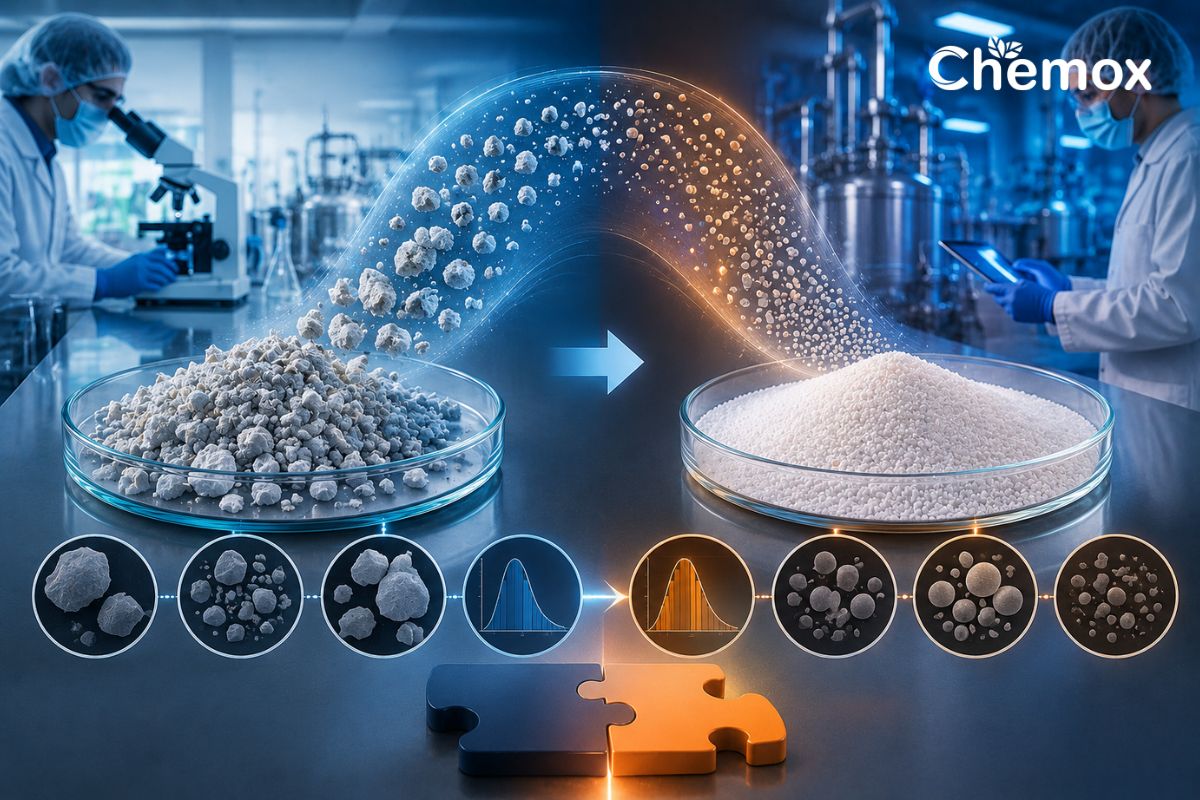
Bridging the Gap: Overcoming Particle Size Distribution Mismatches During Product Tech Transfer
In commercial drug manufacturing, technology transfer is often treated as a linear progression: a process is perfected at the laboratory bench, scaled up in a pilot plant, and ultimately validated on high-speed industrial production lines. Yet, one of the most frustrating and costly phenomena in pharmaceutical engineering is the “phantom failure.” An Active Pharmaceutical Ingredient (API) arrives at the commercial manufacturing facility with impeccable chemical credentials. It passes high-performance liquid chromatography (HPLC) assays with flying colors, meets strict enantiomeric and chemical purity thresholds, and aligns perfectly with the established specification sheets.
However, the moment this chemically pristine powder is introduced into commercial-scale bin blenders, high-speed rotary tablet presses, or encapsulation networks, the process completely unravels. The powder segregates, mechanical dies fill unevenly, weight variations breach compliance margins, or the final solid-dosage forms fail their dissolution test profiles.
The root cause of these unexpected failures is rarely chemical; it is physical. Specifically, it stems from unaddressed particle size distribution mismatches between the R&D clinical batches and the commercial scale-up operations. Understanding the underlying physical chemistry of physical attributes is vital to ensuring a seamless, right-first-time technology transfer.
The Illusion of Chemical Purity
Chemical purity assays tell you what an atom or molecule is, but they tell you absolutely nothing about how that molecule occupies physical space. In solid-dosage engineering, an API behaves simultaneously as an independent compound and as a bulk particulate material. The macro-performance of a powder bed is dictated by its physical characteristics: crystal habit, morphology, surface energy, and notably, its particle size distribution (PSD).
When an API is synthesized in an R&D laboratory, crystallization parameters such as agitation velocity, cooling profiles, and anti-solvent addition rates are governed by small-volume thermodynamics. These laboratory environments naturally tend to yield specific, localized crystal structures and narrow, predictable particle configurations.
When the same chemical synthesis is scaled up to a multi-thousand-liter reactor, the mass and heat transfer dynamics change radically. Even if the chemical transformation remains precise, the physical crystal growth kinetics diverge, creating vastly different physical profiles. If the resulting particle size distribution mismatches are left uncorrected, they disrupt the foundational unit operations of solid-dosage manufacturing.
The Physical Chemistry Behind Scale-Up Failures
To understand why particle size distribution mismatches lead to downstream manufacturing failures, we must analyze how particle profiles influence mechanical and thermodynamic behavior across three critical stages: blending, consolidation, and dissolution.
1. Powder Flow and Rheology: The Interplay of Cohesion and Gravity
As particle diameter decreases, its surface-area-to-volume ratio increases exponentially according to the geometric scaling relation:
$$\frac{SA}{V} \propto \frac{1}{d}$$
where $d$ represents the characteristic particle diameter. This scaling dynamic changes the balance of forces acting within a powder bed. For larger particles, gravitational forces dominate, encouraging fluid flow through hoppers and feed-frames. For finer particles, short-range interparticulate forces—primarily van der Waals attractions, electrostatic charges, and capillary moisture bridges—become dominant over gravity.
If the scaled-up API suffers from a particle size distribution mismatch skewed toward an excessive amount of fine particles, the powder turns highly cohesive. This cohesive shift causes mechanical issues like arching, ratholing, and erratic die filling in high-speed rotary presses, resulting in severe tablet weight and content uniformity variations.
2. Particle Segregation: The Dynamics of Sifting and Percolation
Conversely, if a scaled-up batch contains a wider, multi-modal PSD compared to the R&D reference standard, it triggers percolation segregation during mixing and transport. During transport or bin blending, smaller particles naturally drain through the shifting voids between larger particles under gravity. This separation leaves the finer particles at the bottom of the container while the larger granules congregate near the top.
Because the API is rarely formulated as a pure block—often blended with bulk excipients like microcrystalline cellulose or lactose—any mismatch in particle size distributions between the API and its surrounding matrix causes the active molecules to physically separate from the excipient carrier. When these segregated blends are compressed, some tablets exit the press dangerously hyper-potent, while others are sub-potent, compromising patient safety and failing batch validation tests.
3. Thermodynamic Dissolution Disconnects: The Noyes-Whitney Reality
Perhaps the most challenging aspect of particle size distribution mismatches is their direct impact on the drug’s pharmacokinetic performance. The dissolution rate of an API is mathematically governed by the Noyes-Whitney equation:
$$\frac{dC}{dt} = \frac{DA}{h} \times (C_s – C_t)$$
where $\frac{dC}{dt}$ is the dissolution velocity, $D$ is the diffusion coefficient, $A$ is the effective interfacial surface area, $h$ is the diffusion layer thickness, $C_s$ is the saturation solubility, and $C_t$ is the concentration of the drug at time $t$.
A mismatch that favors larger average particle dimensions shifts the interfacial surface area ($A$) downward. Even if the total mass of the API in a tablet matches the specification exactly, the reduced surface area suppresses the dissolution velocity. For Biopharmaceutics Classification System (BCS) Class II or IV molecules, which possess low baseline solubility, this drop in dissolution velocity can render a clinically validated formulation bioinequivalent and therapeutically ineffective during scale-up.
Mitigating PSD Mismatches: Engineering Solutions at the Particle Level
Resolving particle size distribution mismatches requires moving beyond passive observation and embracing active particle engineering. Rather than forcing a formulation matrix to adapt to an unstable, erratic powder bed, the API itself must be physically tailored to match the specific processing requirements of the target solid-dosage form.
This physical tailoring is achieved by setting precise controls on parameters like $D_{10}$, $D_{50}$, and $D_{90}$—metrics that define the percentage of particles falling below specific micron thresholds. Advanced physical processing techniques can shift and reshape these distributions:
-
Fluid Energy Sieve-Milling and Micronization: Utilizing high-velocity, counter-acting gas streams to induce particle-on-particle collisions. This technique reduces particle sizes into uniform, narrow distributions without introducing heat degradation or chemical contamination.
-
Controlled Co-Crystallization: Tailoring solvent-to-antisolvent precipitation environments inside scalable reactors to lock in targeted crystal habits and size ranges straight from the fluid phase.
-
Mechanical Air Classification: Separating and removing problematic ultra-fine fractions that cause powder stickiness and cohesion from the product stream, preserving the optimal particle matrix.
Accelerate Your Tech Transfer with Chemox Pharma’s Advanced Particle Engineering
At Chemox Pharma, we recognize that launching a commercial drug requires a partner who masters both chemical synthesis and material physics. Our state-of-the-art API manufacturing facilities feature integrated fluid-energy micronization, advanced mechanical classification, and real-time laser diffraction PSD profiling.
Whether your solid-dosage line requires custom micronized distributions to maximize dissolution rates or highly optimized, free-flowing distributions for high-speed tableting, our engineering teams are ready to deliver tailored particle architectures built to your exact specifications.
Partner with us to de-risk your scale-up pipeline: Contact our R&D tech-transfer desk today at bd@chemoxpharma.com to share your dissolution specifications and request a custom engineered pilot-batch evaluation.