Citicoline Sodium vs Citicoline: Key Differences Explained
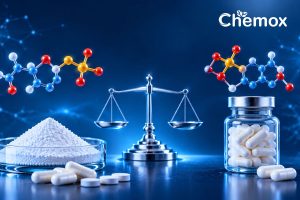
If you are comparing citicoline sodium vs citicoline, the short answer is that they are the same active molecule in two different forms. Citicoline is the parent compound, also called CDP-choline. Citicoline sodium is its monosodium salt. The difference matters in practice for molecular weight, dose labeling, pharmacopoeial standards and how you specify the material when you buy it.
This guide is written by Chemox Pharma, a WHO-GMP certified citicoline sodium API manufacturer based in Dahej, Gujarat. It explains what is the same, what is different, and what formulators and buyers should check before choosing one.
This article is for industry and educational purposes only. It is not medical advice. Anyone considering a supplement or medicine should speak to a doctor or pharmacist.
Quick answer
| Citicoline | Citicoline sodium | |
|---|---|---|
| What it is | The parent molecule (cytidine 5′-diphosphocholine, CDP-choline), the free “inner salt” form | The monosodium salt of citicoline |
| CAS number | 987-78-0 | 33818-15-4 |
| Molecular formula | C14H26N4O11P2 | C14H25N4NaO11P2 (often supplied as a hydrate, written ·xH2O) |
| Molecular weight | 488.33 | 510.31 (anhydrous basis) |
| USP-NF monograph | Citicoline: assay 98.0% to 102.0% on the dried basis | Citicoline Sodium: assay 98.0% to 102.0% on the anhydrous basis |
| Also called | CDP-choline, cytidine diphosphate choline | Citicoline sodium salt, CDP-choline sodium |
Sources for each row are listed at the end of this post. The formulas, weights and CAS numbers come from supplier and reference-standard data sheets, and the assay ranges come from USP-NF monograph previews.
What is the same
Both forms deliver the same active citicoline molecule. Once taken, citicoline is broken down rapidly into its two building blocks, choline and cytidine (humans appear to show this mainly as uridine in plasma). A review of citicoline’s pharmacology by Grieb, published in CNS Drugs in 2014, describes this hydrolysis as happening “within minutes rather than hours” after oral or parenteral dosing, and quotes another paper stating that the sodium salt is likewise hydrolysed to choline and cytidine.
That review did not analyse the sodium salt’s pharmacokinetics separately, and I did not find a head-to-head comparison of the two forms in the sources reviewed for this article. So the statement “they behave the same once dissolved” is a reasonable chemical expectation, not something the sources prove. If a product claim depends on equivalence, ask for the underlying data.
Citicoline sodium vs citicoline: what is different
1. Molecular weight and the dose-equivalence calculation
The sodium ion adds mass. Citicoline weighs 488.33 and citicoline sodium weighs 510.31 on an anhydrous basis, so the ratio is about 0.957.
In practical terms, 1,000 mg of citicoline sodium (anhydrous) contains roughly 957 mg of citicoline. That is our own arithmetic from the published weights. Real material also contains water, because the sodium salt is commonly supplied as a hydrate, so the actual citicoline content per gram depends on the batch’s water content and assay.
This is why labels matter. A product labeled “500 mg citicoline” and one labeled “500 mg citicoline sodium” are not strictly the same amount of active molecule. Formulators should state the basis clearly (as citicoline, or as citicoline sodium on an anhydrous or as-is basis) and calculate from the certificate of analysis.
2. Separate pharmacopoeial monographs
USP-NF lists separate dietary supplement monographs for the two materials. The Citicoline Sodium monograph sets a 98.0% to 102.0% assay on the anhydrous basis, and names two reference standards, USP Citicoline Sodium RS and USP 5′-Cytidylic Acid RS. The Citicoline monograph sets the same assay range on the dried basis. The USP previews I could access do not show the impurity, endotoxin or water limits, which sit behind a subscription. Because these are dietary supplement monographs, buyers of pharmaceutical-grade material should confirm which pharmacopoeia and grade their market and product require.
3. Hydrate and water content
Reference-standard sheets list the sodium form as a hydrate (C14H25N4NaO11P2 · xH2O), and USP assays it on the anhydrous basis. That means water content is a key specification for citicoline sodium and should appear on the certificate of analysis.
4. Handling and stability
Supplier data sheets for both forms recommend careful storage. One data sheet for the free form describes it as moisture sensitive and recommends freezer storage under an inert atmosphere, and reference-standard sheets for the sodium form list storage at −20 °C. Those conditions apply to small analytical-standard quantities and do not necessarily describe bulk API storage.
A 2019 article by a physician linked to a sodium citicoline brand states that the sodium salt is more stable than the base form and is favored by formulators. That claim comes from a company-linked, promotional source, so treat it as a claim to verify with supplier stability data, not as established fact.
5. Availability and history
The same 2019 article describes the sodium salt as the original oral form, the most widely used worldwide and the most researched, with nearly 100 published trials. Again, that is a promotional source. What can safely be said is that the sodium salt is widely listed by suppliers and reference-standard providers, with its own CAS number and USP monograph.
Reading product labels
The names used on labels vary, which causes confusion. All of the following may refer to the same family of materials:
- Citicoline
- CDP-choline or cytidine diphosphate choline
- Cytidine 5′-diphosphocholine
- Citicoline sodium or citicoline sodium salt
- CDP-choline sodium
Check whether the stated amount is for citicoline itself or for the sodium salt, and whether the basis is anhydrous or as-is. If the label does not say, ask the manufacturer.
Which one should you choose?
There is no universal winner. The right choice depends on what you are making and what your reference documents require.
- Replicating an existing product or monograph: use the form your reference product, registration or pharmacopoeial standard specifies.
- New formulation work: compare solubility, stability and handling for your dosage form using supplier data and your own trials. Do not rely on general marketing claims.
- Label claims: decide the basis (citicoline or citicoline sodium) early and apply the molecular-weight conversion consistently.
- Regulatory filings: match the form named in your dossier, and check which monograph applies.
- Working with citicoline sodium: as a citicoline sodium API manufacturer, Chemox Pharma can supply this form and discuss specifications for your intended use (see below).
What to ask any citicoline sodium API manufacturer (including us)
- Which exact form is supplied, and under which CAS number
- Assay, stated on the anhydrous or dried basis
- Water content and, for the sodium salt, how the hydrate is specified
- Related substances, including 5′-cytidylic acid, residual solvents, elemental impurities and microbial limits
- Endotoxin limits if the material is for parenteral use
- Stability data and the recommended storage and retest period
- GMP status and the regulatory documentation available for your market
Citicoline sodium API from Chemox Pharma
Chemox Pharma is a WHO-GMP certified manufacturer and exporter of active pharmaceutical ingredients and intermediates, based in Dahej, Gujarat, India. Citicoline sodium is part of our API portfolio.
When you enquire about citicoline sodium API from Chemox, you can expect:
- A clear statement of the form supplied, citicoline sodium, with the assay basis and specification stated so you can apply the conversion described above.
- Documentation on request, including a certificate of analysis and safety data sheet, and the regulatory documents available for your target market.
- Technical discussion of specifications, packaging, samples and quality requirements for pharmaceutical or nutraceutical use.
- Export support for buyers in global markets.
Indian manufacturers account for a large share of recorded citicoline sodium API export shipments in customs-based trade data, so buyers often compare several India-based sources. Whichever supplier you choose, use the checklist above to qualify them.
Frequently asked questions
Is citicoline sodium the same as citicoline?
They share the same active molecule, but they are different chemical forms. Citicoline sodium is the monosodium salt of citicoline, with its own CAS number (33818-15-4) and molecular weight (510.31, anhydrous) compared with citicoline (CAS 987-78-0, 488.33).
Is citicoline sodium better than citicoline?
The sources I reviewed do not show a head-to-head comparison proving one is better. Some promotional sources favor the sodium salt for stability, but that claim should be checked against supplier data for your own use.
How do I convert between citicoline and citicoline sodium doses?
Divide the molecular weights: 488.33 / 510.31 is about 0.957. So 1,000 mg of citicoline sodium (anhydrous) corresponds to roughly 957 mg of citicoline. Actual material contains water, so use the certificate of analysis. This is a chemistry calculation, not dosing advice.
Do they have different pharmacopoeial standards?
In USP-NF, yes. There is a Citicoline Sodium monograph (assay 98.0% to 102.0%, anhydrous basis) and a separate Citicoline monograph (assay 98.0% to 102.0%, dried basis). The previews I accessed do not show the impurity or endotoxin limits.
Are citicoline and CDP-choline the same thing?
Yes. CDP-choline (cytidine diphosphate choline) is another name for citicoline.
Does Chemox Pharma manufacture citicoline sodium API?
Yes. Chemox Pharma is a WHO-GMP certified API manufacturer in Dahej, Gujarat, and citicoline sodium is part of our portfolio. Contact us for the specification sheet, documentation and samples.
What documents can I request from Chemox for citicoline sodium?
You can ask for a certificate of analysis, a safety data sheet and the regulatory documentation available for your market. Tell us your target country and intended use so we can confirm what applies.
What should I specify when ordering citicoline API?
State the form (citicoline or citicoline sodium), the CAS number, the assay basis, the pharmacopoeia or in-house specification, water content, impurity limits and any endotoxin requirement, and ask for the certificate of analysis and stability data.
Talk to Chemox Pharma about citicoline sodium API
Looking for a citicoline sodium API manufacturer? Chemox Pharma is a WHO-GMP certified API and intermediates manufacturer based in Dahej, Gujarat, supplying customers across global markets. Tell us the form, assay basis, quantity and target market, and our team will share the specification, documentation and sample details.