
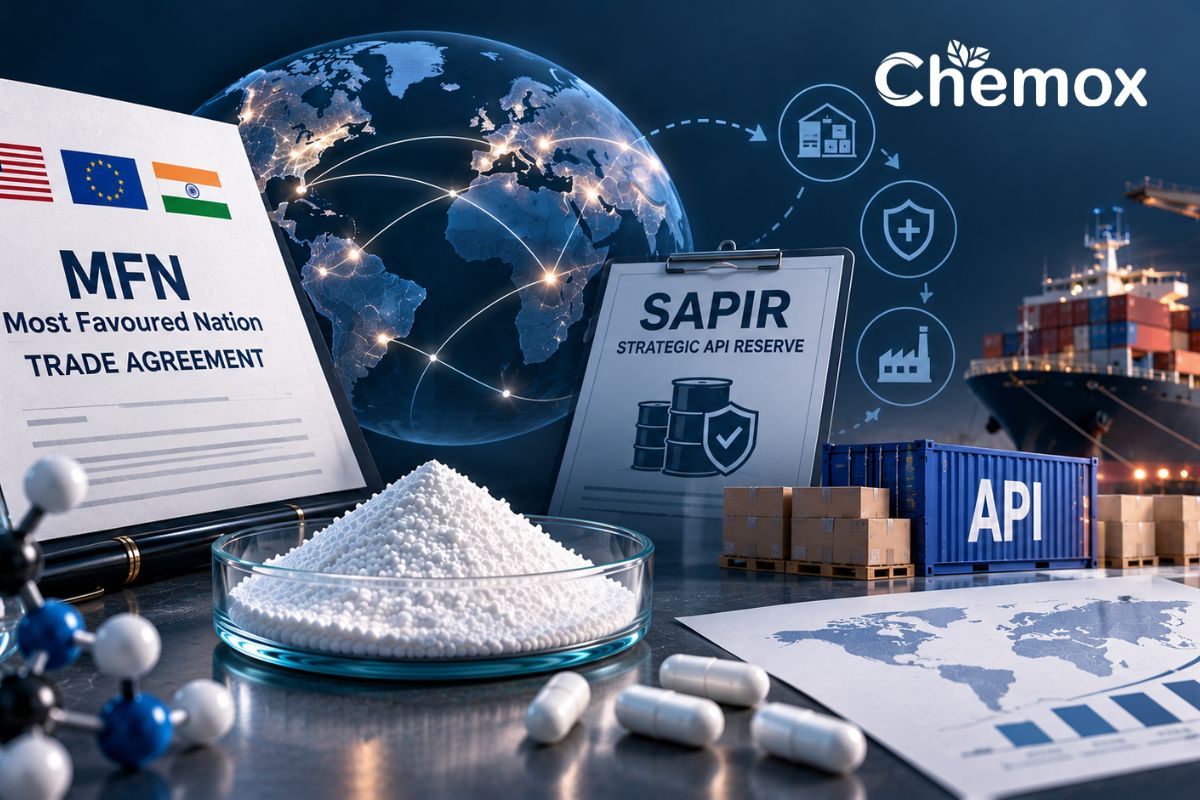
How the New MFN Pharma Deals and SAPIR Stockpiles Impact Generic API Exporters
A series of US policy moves through 2025 and 2026 have been quietly reshaping the incentives around where active pharmaceutical ingredients get sourced from and the latest wave of developments deserves more attention from generic API exporters than it’s getting. Between steep tariff threats on pharmaceutical imports, Most Favored Nation (MFN) pricing deals tied to domestic manufacturing commitments, and a national API stockpile called SAPIR, the US is building a policy framework explicitly aimed at reducing reliance on foreign API sources. Understanding MFN pharma deals and SAPIR stockpile commitments matters even for exporters not directly named in these agreements.
What Is SAPIR?
The Strategic Active Pharmaceutical Ingredients Reserve (SAPIR) is a US government initiative to stockpile a roughly six-month supply of APIs for approximately 26 critical drugs, alongside a broader plan to secure supply for 86 essential medicines, with explicit priority given to US-made ingredients. It’s been described as a pharmaceutical equivalent of the Strategic Petroleum Reserve a proactive, government-held buffer against supply disruption rather than a reactive response after shortages occur. The concept originated during an earlier policy push and has since been formalized through executive action directing the relevant federal health authority to build out the reserve.
The underlying problem statement driving this: only around 10% of the APIs used in US drug products are currently manufactured domestically, with the large majority sourced from abroad.
The MFN Deals and What Companies Are Actually Committing
As part of a broader Most Favored Nation drug pricing push, the number of pharmaceutical companies signing MFN agreements with the US government has grown to roughly 26, spanning both large multinational pharma companies and a more recent wave of mid-sized drugmakers — including companies headquartered in India, Israel, Japan, and Australia. These newer signatories have collectively pledged close to $19.6 billion toward US manufacturing investment.
Notably, several participating companies have agreed to directly contribute API tonnage to the SAPIR stockpile as part of their deals including donations of apixaban, levetiracetam, clindamycin, doxycycline, metronidazole, amlodipine, and tacrolimus from various signatories, reportedly at no direct cost to taxpayers. It’s worth noting that at least one Indian pharmaceutical company is among the signatories making these API contributions, showing that Indian-origin supply isn’t excluded from this framework — though the structural incentive clearly favors companies large enough to negotiate an MFN deal and commit to onshoring, which smaller generic API exporters typically can’t do independently.
The Tariff Pressure Behind These Incentives
These deals exist against a backdrop of significant tariff pressure on pharmaceutical imports, with steep tariff rates discussed for standard imports and a 0% rate reportedly available only to companies that sign MFN pricing agreements and commit to onshoring production. The exact tariff landscape has continued to evolve, so exporters should treat any specific rate as subject to change rather than settled policy, and monitor official announcements directly rather than relying on secondhand summaries.
What This Means for Generic API Exporters
- Check whether your product categories overlap with the SAPIR lists. The reserve currently centers on a defined set of roughly 26 critical drugs and 86 essential medicines — if your API falls within or adjacent to these categories, this policy direction is more directly relevant to your market positioning than it would be for products outside that scope.
- Don’t assume blanket exemption or blanket exposure. The MFN/SAPIR framework primarily applies to specific signatory companies and named products — most generic API trade falls outside this specific mechanism, even as the broader reshoring signal affects buyer sentiment more generally.
- Expect increased buyer interest in supply chain resilience conversations, even for molecules not directly named in SAPIR, as US-based formulators factor geopolitical and policy risk more explicitly into their sourcing decisions.
- Specialty and well-documented niche API positioning remains a more resilient strategy than competing purely on commodity-generic trade exposed to tariff uncertainty — consistent with the broader dynamic discussed in our piece on India-China pharma deals and API economics.
- Monitor policy developments directly rather than planning around a single snapshot of current rates or lists, since this is an actively evolving area of US trade and health policy.
Chemox Pharma’s Approach to This Landscape
Chemox Pharma tracks these policy developments as part of our broader approach to supply chain strategy, while continuing to focus on specialty and niche API and intermediate manufacturing at our WHO-GMP certified facility in Dahej, Gujarat — a positioning that’s less directly exposed to policy shifts targeting specific named commodity categories, while still supporting buyers who need well-documented, consistent supply regardless of which market dynamics shift next.
Request a Quote or Discuss Your Sourcing Strategy
If evolving US trade and stockpiling policy is factoring into how you’re planning your API sourcing strategy, get in touch with Chemox Pharma to discuss your specific requirements.
FAQs
Q: What is SAPIR? The Strategic Active Pharmaceutical Ingredients Reserve is a US government initiative to stockpile roughly a six-month supply of APIs for about 26 critical drugs, plus a broader plan covering 86 essential medicines, prioritizing US-made ingredients.
Q: Do MFN pharma deals apply to generic API exporters directly?
Generally, MFN deals and SAPIR contributions have so far involved specific signatory pharmaceutical companies and named products, rather than applying as a blanket policy across all generic API trade though the broader reshoring trend affects buyer sentiment more widely.
Q: Are Indian companies excluded from participating in SAPIR?
No. At least one major Indian pharmaceutical company is among the signatories contributing API to the reserve, though the structural incentive favors companies large enough to negotiate MFN pricing deals and commit to US onshoring investment.
Q: Should generic API exporters be worried about these developments?
It depends heavily on whether your specific product categories overlap with the SAPIR critical/essential medicines lists. Given how actively this policy area is evolving, monitoring official developments directly is more useful than assuming a fixed outcome.