
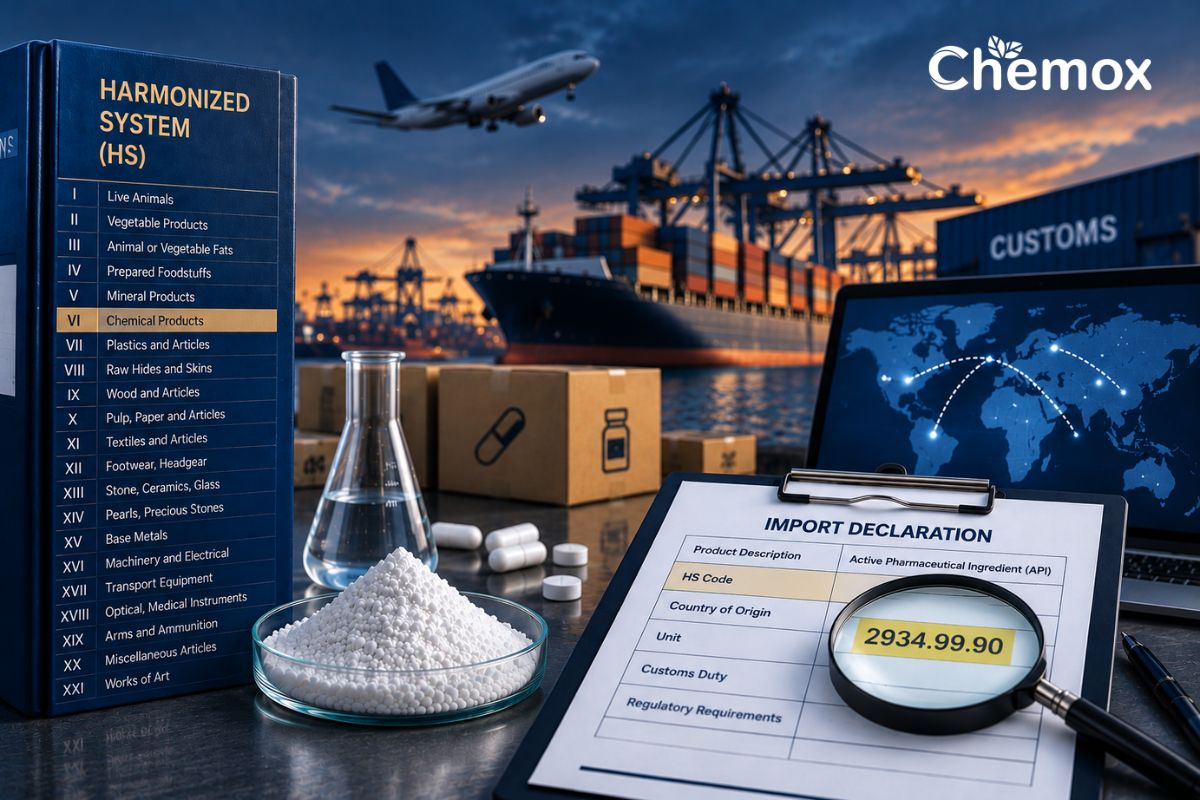
HS Code Classification for API Imports: Why Getting It Wrong Costs You at Customs
An incorrect HS code on an API shipment isn’t a paperwork technicality it’s one of the most common, avoidable causes of customs delays, duty overpayment, and in more serious cases, penalties on audit. Yet it’s a detail that gets surprisingly little attention compared to the documentation buyers usually focus on, like CoAs and GMP certificates. Getting HS code classification for API imports right matters just as much to your landed cost and clearance timeline.
This guide covers what an HS code actually is, where APIs typically fall within it, and why classification isn’t as simple as looking up a single universal number.
What Is an HS Code?
The Harmonized System (HS) is an internationally standardized numerical classification system, maintained by the World Customs Organization, used to classify traded goods for customs purposes. The first six digits are standardized globally, meaning the same product should carry the same six-digit code regardless of which country it’s entering. Beyond that, individual countries extend the code to eight or ten digits for their own tariff and statistical purposes which is exactly where classification can get confusing for API buyers working across multiple import markets.
Where APIs Typically Fall Within the HS System
This is a distinction that trips up a surprising number of first-time importers: bulk active pharmaceutical ingredients and finished pharmaceutical products often fall under entirely different chapters of the HS system.
- Chapter 29 (Organic Chemicals) generally covers bulk, unformulated active substances defined by their chemical structure — many APIs fall here, under headings that vary by chemical class (for example, heterocyclic compounds, antibiotics, hormones, or alkaloids each have their own relevant headings within this chapter).
- Chapter 30 (Pharmaceutical Products) generally covers finished, formulated medicaments — tablets, capsules, and other dosage forms ready for patient use.
This distinction matters because duty treatment can differ meaningfully between the two. Finished pharmaceutical products classified under Chapter 30 are often eligible for duty-free treatment in many countries under international pharmaceutical trade agreements, while bulk chemical-stage APIs under Chapter 29 don’t automatically receive the same treatment unless the specific substance appears on a country’s own pharmaceutical exemption list.
Why Misclassification Costs You
- Overpaying duty. Classifying an API under a code with a higher applicable duty rate than the correct one means paying more than necessary on every shipment, indefinitely, until someone catches the error.
- Underpaying duty and facing penalties. The reverse situation — classifying under a lower-duty code, whether by mistake or otherwise — creates exposure to back-duty assessments, fines, and increased scrutiny on future shipments if caught during a customs audit.
- Shipment holds and delays. Ambiguous or apparently incorrect classification can trigger a customs review, holding your shipment at port while the classification is verified — directly impacting your production timeline.
- National tariff line differences. Because the code beyond six digits varies by country, a classification that’s correct for one import market may not directly apply to another without verification against that specific country’s tariff schedule.
Why You Can’t Just Use One “Standard” Code
Because national tariff schedules extend the international six-digit HS code differently — the US Harmonized Tariff Schedule, the EU’s TARIC system, and India’s ITC-HS classification each apply their own extensions — the same API can carry different full classification codes depending on where it’s being imported. A code that cleared customs smoothly in one country isn’t a reliable reference for a shipment to a different country.
Best Practices for API Buyers
- Confirm classification with a licensed customs broker in your destination country rather than relying solely on a supplier-provided code.
- Check your country’s pharmaceutical duty exemption list, since many countries offer duty-free treatment for specific pharmaceutical substances under international trade agreements — but only if correctly classified and documented as such.
- Request an advance ruling where available. Several countries’ customs authorities offer binding classification rulings on request, removing ambiguity before your shipment arrives.
- Treat your supplier’s invoice HS code as a reference, not a final answer. As the importer of record, classification responsibility ultimately rests with you, not your supplier.
- Keep documentation consistent across your invoice, packing list, and customs declaration — inconsistent codes across shipment paperwork is a common trigger for customs review.
HS Code Support at Chemox Pharma
Chemox Pharma provides HS code references on export documentation and invoices as a starting point for buyers. Since final classification responsibility rests with the importer of record, we recommend confirming applicable codes with your customs broker for your specific destination market — and our team is happy to work with you and your broker to make sure documentation is consistent and accurate on our end.
Questions to Ask Before Your Next Shipment
- Has this HS code been confirmed for my specific destination country, or is it a general reference?
- Does my country’s tariff schedule offer duty-free treatment for this specific pharmaceutical substance?
- Is my documentation (invoice, packing list, customs declaration) consistent in the code used?
- Should I request an advance classification ruling for a new product or destination market?
Request a Quote and Documentation Support
If you’re placing an order and want export documentation that supports accurate customs classification, get in touch with Chemox Pharma for a quote and documentation discussion.
FAQs
Q: Do bulk APIs and finished pharmaceutical products use the same HS code?
Not typically. Bulk, unformulated APIs generally fall under Chapter 29 (Organic Chemicals), while finished dosage forms generally fall under Chapter 30 (Pharmaceutical Products) — a distinction that can significantly affect applicable duty rates.
Q: Is the same HS code valid for importing into any country?
Only the first six digits are internationally standardized. Countries extend the code further for their own tariff schedules, so the full classification code can differ between import markets and should be confirmed for each destination.
Q: Who is responsible for correct HS code classification — the supplier or the buyer?
The importer of record is generally responsible for correct classification, even though a supplier’s invoice may reference a code. Buyers should independently confirm classification with a customs broker in their destination country.
Q: Can APIs qualify for duty-free import treatment?
In some countries, yes — many jurisdictions offer duty-free treatment for specific pharmaceutical substances under international trade agreements, but only if the substance is correctly classified and appears on that country’s exemption list.