API Intermediate Market Growth 2026–2030: Why Demand for High-Purity Intermediates Is Rising
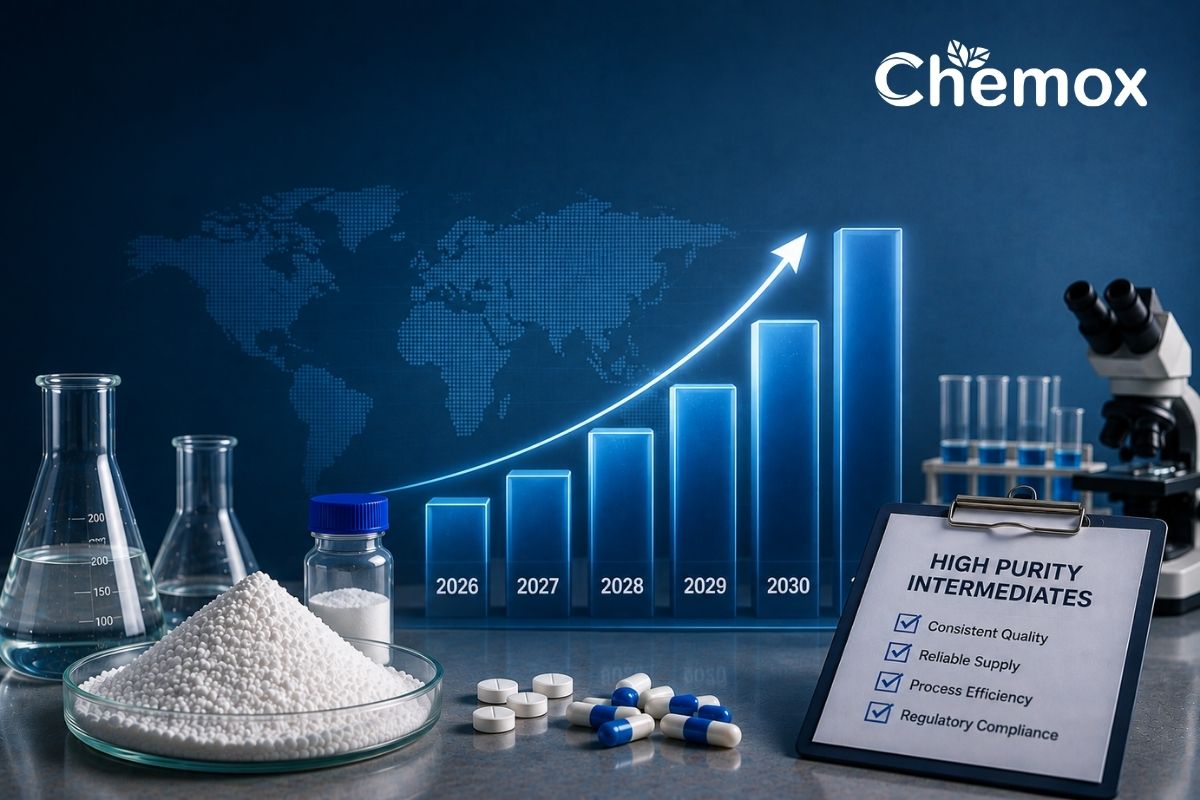
While most sourcing conversations focus on finished APIs, the intermediates behind them are seeing some of the fastest growth in the entire pharmaceutical supply chain. Recent industry analysis forecasts the global API intermediate market to reach $220.78 billion by 2030, growing at a 7.4% compound annual growth rate — a pace that reflects real structural shifts in how generic manufacturers are sourcing, not just overall pharmaceutical market expansion.
This piece looks at what’s actually driving intermediate market growth through 2026 and beyond, and why high-purity intermediates specifically are becoming a bigger priority for buyers.
What’s Driving Intermediate Market Growth
Reshoring and Supply Chain Diversification
As pharmaceutical companies work to reduce geographic concentration risk in their supply chains, demand for intermediate manufacturing capacity outside traditional single-source regions has grown. This has pushed more buyers to evaluate backward-integrated intermediate suppliers who can offer supply chain visibility further up the synthesis chain, rather than depending on a single opaque source.
Tightening Regulatory Oversight on Impurities
Regulatory scrutiny of impurity profiles particularly genotoxic and elemental impurities under ICH Q3 guidelines has increased steadily across major markets. This has a direct knock-on effect for intermediates: since impurities present in early and mid-stage intermediates often carry through into the finished API, buyers are increasingly specifying tighter purity requirements at the intermediate stage rather than relying solely on final-product testing to catch problems.
Synthesis Technology Breakthroughs
Advances in continuous-flow manufacturing, biocatalysis, and other process innovations have improved both the purity achievable at the intermediate stage and the consistency of that purity across batches. Manufacturers investing in these capabilities are increasingly able to offer intermediates that meet stricter buyer specifications than were commonly achievable a few years ago.
Growing Generic Drug Manufacturing Expansion
As non-communicable disease treatment volumes continue rising globally, generic drug manufacturing has expanded correspondingly and with it, demand for the intermediate supply that feeds generic API production. This is particularly relevant for high-volume therapeutic categories like cardiovascular and antihypertensive drugs, where intermediate demand scales directly with API production volume.
Increased CDMO and Outsourced Manufacturing Collaboration
More pharmaceutical companies are shifting from in-house (captive) intermediate production toward outsourced, merchant-market sourcing a structural shift that’s expanding the addressable market for dedicated intermediate manufacturers who can offer consistent quality and documentation support at scale.
Why High-Purity Intermediates Matter More Now Than Before
For late-stage intermediates in particular, purity isn’t just a quality nice-to-have it directly determines downstream yield and impurity carryover into the finished API. A buyer sourcing an intermediate with marginal purity is effectively pushing a purification burden downstream into their own process, adding cost and complexity that a higher-purity starting material would have avoided.
This is especially relevant for synthesis routes with multiple sequential intermediate stages where impurities introduced early in the chain compound through each subsequent reaction rather than being purged at a single purification step.
What This Means for Buyers
- Specify purity requirements explicitly when sourcing intermediates, rather than assuming a generic “GMP” claim covers the impurity control your synthesis route actually needs.
- Ask whether your supplier manufactures the intermediate in-house or is reselling material sourced elsewhere — purity consistency is harder to guarantee across a trading relationship than a direct manufacturing one.
- Consider backward-integrated suppliers who manufacture multiple stages of your synthesis chain, since this generally means tighter overall quality control and fewer handoff points where inconsistency can be introduced.
- Request batch-specific impurity data, not just a general specification sheet, particularly for late-stage intermediates feeding directly into your final API step.
Intermediate Manufacturing at Chemox Pharma
Chemox Pharma manufactures pharmaceutical intermediates — including DMDO-CL, OLMI-1, and TTBB for Olmesartan Medoxomil synthesis — at our WHO-GMP certified facility in Dahej, Gujarat. As demand for high-purity, well-documented intermediate supply continues to grow, our backward-integrated production model allows generic API manufacturers to source multiple synthesis-chain intermediates from a single, accountable factory.
Request a Quote for Intermediates
If you’re sourcing pharmaceutical intermediates and want consistent, high-purity supply backed by real documentation, get in touch with Chemox Pharma for a quote and sample evaluation.
FAQs
Q: How fast is the API intermediate market expected to grow through 2030?
The global API intermediate market is forecast to reach $220.78 billion by 2030, growing at a compound annual growth rate of approximately 7.4%.
Q: Why does intermediate purity matter more now than it used to?
Tightening regulatory scrutiny on impurities, particularly under ICH Q3 guidelines, means impurities carried through from intermediates increasingly show up as a problem at the finished-API stage, making intermediate-level purity control more important than before.
Q: What’s driving demand for backward-integrated intermediate suppliers?
Buyers looking to reduce supply chain risk and improve quality consistency are increasingly favoring manufacturers who produce multiple stages of a synthesis chain in-house, rather than sourcing each intermediate from a different trader.
Q: Does Chemox Pharma manufacture intermediates in-house?
Yes. Chemox Pharma manufactures Olmesartan Medoxomil intermediates — DMDO-CL, OLMI-1, and TTBB — at its own WHO-GMP certified facility in Dahej, Gujarat.