Certificate of Analysis in Pharma: What Every Global Buyer Must Know
Every kilogram of Active Pharmaceutical Ingredient that crosses an international border carries with it a document that can make or break a regulatory submission, a shipment clearance, or a patient’s safety: the Certificate of Analysis. Yet despite its critical importance, many pharmaceutical procurement teams particularly those new to sourcing APIs from India or other international manufacturers do not fully understand what a certificate of analysis in pharma document must contain, how to read it correctly, or how to identify a fraudulent or non-compliant one before it causes serious problems.
This guide covers everything a global API buyer needs to know about the Certificate of Analysis — what it is, why it matters, what every compliant CoA must include, how to read one like a regulatory expert, and the seven red flags that should stop any procurement decision in its tracks.
What Is a Certificate of Analysis in Pharma?
A Certificate of Analysis (CoA) is an official document issued by the Quality Control department of a pharmaceutical manufacturer including API manufacturers — that reports the actual test results for a specific batch of material, confirming that the batch meets predetermined specifications and applicable regulatory requirements.
In simpler terms: a CoA is the API’s quality report card. It tells the buyer exactly what was tested, what the acceptance criteria were, and what the actual results showed — batch by batch, test by test.
In pharmaceutical and biopharmaceutical manufacturing, CoAs are mandated by regulatory frameworks including the FDA’s 21 CFR Part 211 (cGMP) and the European Medicines Agency’s Good Manufacturing Practice guidelines. Every batch of active pharmaceutical ingredient must be accompanied by a CoA before it can be released for use in finished drug product manufacturing. Without a compliant, verifiable CoA, an API batch cannot legally or ethically be incorporated into a medicine intended for patient use.
The certificate of analysis in pharma document is not a generic quality statement or a letter of conformance it is a batch-specific, data-rich document that must contain actual numerical test results, not merely pass/fail declarations. This distinction is critical and is one of the most common CoA deficiencies observed during regulatory inspections.
Why the CoA Is the Single Most Important Document in API Sourcing
For global pharmaceutical buyers sourcing APIs from India or any other international source, the CoA performs four essential functions simultaneously:
Quality verification: The CoA is the primary tool for confirming that the API batch meets the identity, purity, potency, and safety specifications required for your finished dosage form. A mismatch between CoA data and your own independent testing results is a serious quality event requiring full investigation before the batch can be used.
Regulatory compliance evidence: Regulatory authorities including the USFDA, EMA, and WHO require pharmaceutical manufacturers to review and verify incoming API CoAs against approved specifications before batch release. During GMP inspections, inspectors routinely review incoming CoA records as part of their assessment of a manufacturer’s supplier quality management system.
Import and customs clearance: In many regulatory jurisdictions including EU member states and regulated Asian markets a compliant CoA from the API manufacturer is a mandatory document for customs clearance and import authorization. A missing, expired, or non-compliant CoA can result in shipment holds, rejection at port, and significant commercial disruption.
Traceability and recall readiness: The batch number documented on the CoA links the API supply to every downstream manufacturing record from the drug product batch record through to the finished medicine’s release documentation. In the event of a product recall, this traceability chain is essential for rapid identification and containment of affected batches.
What a Compliant Certificate of Analysis API Pharma Document Must Contain
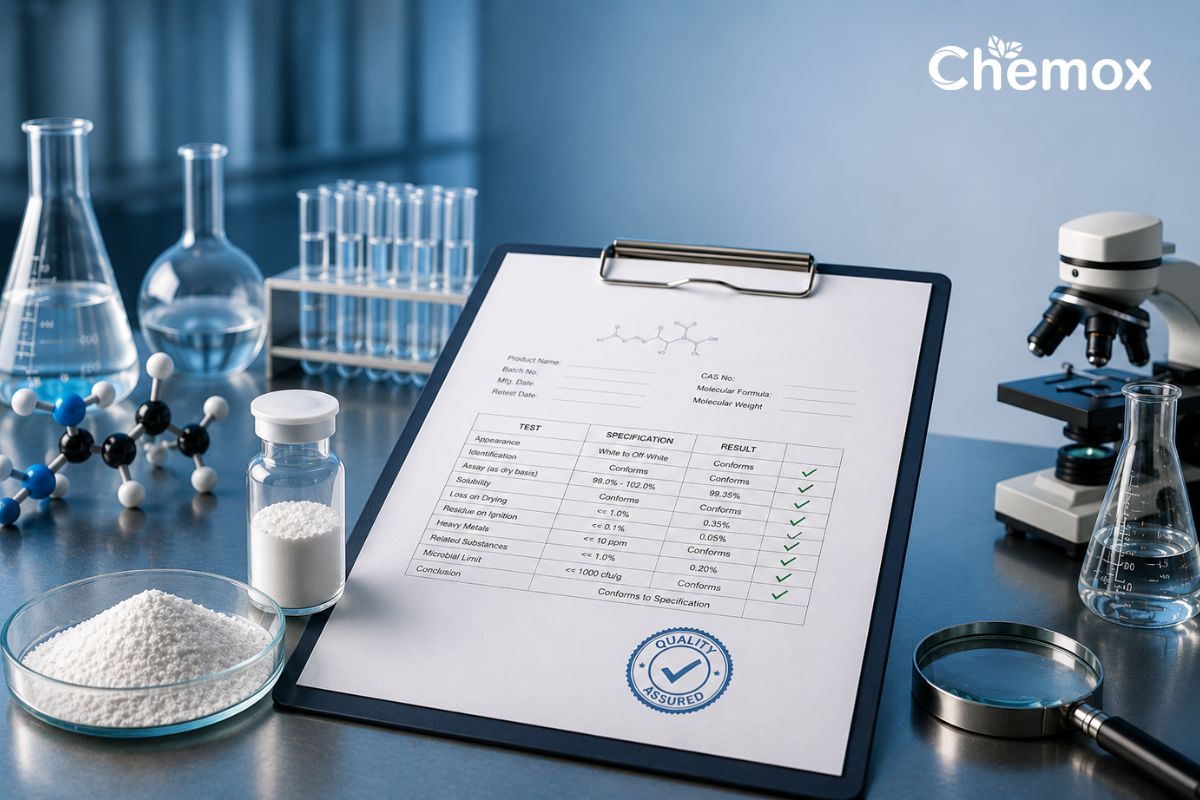
Per ICH Q7 guidelines and the regulatory expectations of the USFDA and EMA, every pharmaceutical API Certificate of Analysis must include the following elements. Buyers should use this as a verification checklist every time a new CoA is received:
1. Product Identification
- Full chemical name of the API (and approved INN/USAN name where applicable)
- CAS Registry Number
- Pharmacopoeial grade (USP, BP, EP, IP, or as applicable)
- Lot/batch number — unique to this specific manufactured batch
- Manufacturing date and retest or expiry date
- Quantity manufactured in the batch
2. Manufacturer and Supplier Details
- Full legal name and address of the manufacturing site (not the trading office or agent)
- Name and address of the supplier if different from the manufacturer
- Signature and designation of the authorized Quality Control officer who reviewed and approved the CoA
3. Test Parameters, Specifications, and Results
This is the core of the document. Every test parameter must show three columns: the test name, the acceptance specification, and the actual numerical result obtained. Key parameters for a compliant API CoA include:
- Description/Appearance — physical form, color, and odor per pharmacopoeial monograph
- Identity — IR, UV, or HPLC-based identity confirmation against reference standard
- Assay (Purity) — typically by HPLC, with acceptance range (e.g., 98.0%–102.0%), with the actual result shown numerically
- Related substances/Impurities — individual named impurities and total impurity limits per ICH Q3A, with actual quantified results
- Residual solvents — Class 1, 2, and 3 solvents per ICH Q3C, with actual GC-based numerical results
- Water content — Karl Fischer determination result
- Heavy metals — particularly for orally administered APIs
- Microbial limits — total aerobic microbial count, total yeast and mold count, specified organism absence testing
- Particle size distribution — where relevant to the API’s bioavailability or formulation performance
- Specific optical rotation — for chiral APIs where stereochemical identity is specification-critical
- pH — for APIs in aqueous solution or where pH is a pharmacopoeial specification
4. Test Methods Referenced
Every test parameter must reference the specific test method used — pharmacopoeial method (e.g., USP <621>, BP appendix, EP chapter) or validated in-house method with a method reference number.
5. Dates
- Date of manufacture
- Date of analysis (must be batch-specific and recent — not recycled from a previous batch)
- Retest date or expiry date
How to Read a Certificate of Analysis: Step-by-Step
When you receive a CoA from an API supplier, follow this structured review process before accepting the batch for use:
Step 1 — Verify identity fields first. Confirm the product name, CAS number, batch number, and manufacturing site match your purchase order, shipping documents, and approved supplier list. Any mismatch is a stop-and-investigate event.
Step 2 — Check the date of analysis. The CoA must be batch-specific and current. A CoA dated significantly before the batch manufacturing date — or recycled from a previous batch with only the lot number changed — is a data integrity red flag. Testing should have been completed on this specific batch.
Step 3 — Read assay results numerically. Do not accept a CoA that states only “Complies” or “Pass” for assay. You need the actual HPLC percentage figure. A result of 99.4% is very different from 98.1% — both may “pass” a 98.0%–102.0% specification, but the numerical difference matters for your formulation development and process validation records.
Step 4 — Review impurity profiles carefully. Check every specified impurity against its individual limit. Note any impurity result that is close to its ICH Q3A threshold — a result of 0.09% against a 0.10% limit is technically compliant, but is close enough to warrant a supplier conversation about process robustness and batch-to-batch consistency.
Step 5 — Verify the authorized signature. A legitimate CoA must be signed by a named, qualified Quality Control officer — not a generic stamp or a digital signature without an identity trail. The signatory’s designation (e.g., Head of Quality Control, QC Manager) should be clearly stated.
Step 6 — Cross-reference with your approved specifications. Compare every CoA parameter result against your own internal approved specification for the API — not just the supplier’s stated specification. If your formulation requires tighter particle size limits or a lower total impurity threshold than the supplier’s standard CoA specification, this must be contractually agreed and documented in your Quality Agreement.
7 Red Flags on a Certificate of Analysis API Pharma Document
These warning signs should trigger immediate investigation and should pause any batch acceptance decision:
Red Flag 1 — Results that exactly match specifications on every single parameter. Real analytical testing always shows some variability. If every result matches the specification limit precisely for example, assay “99.0%” against a “NLT 98.0%” spec, across every parameter — this is a statistical impossibility in real testing and suggests results may have been fabricated or copy-pasted.
Red Flag 2 — Only “Pass/Complies” stated without numerical results. A CoA that does not report actual numerical data for assay, impurity, or other quantitative tests does not comply with ICH Q7 or GMP requirements. Regulators require actual test results, not summary statements.
Red Flag 3 — Missing batch number or batch number that does not match delivery documents. A mismatch between the batch number on the CoA and the batch number on the shipping documents, drum labels, or invoice is a serious data integrity finding. Never accept an API batch where the CoA batch number cannot be independently verified against physical labels.
Red Flag 4 — CoA issued by an agent or trader, not the manufacturing site. The CoA must be issued by the Quality Control department of the actual manufacturing facility where the API was produced. A CoA issued by a trading company, broker, or distribution agent — rather than the manufacturer — does not meet GMP requirements and provides no assurance of the underlying analytical data’s integrity.
Red Flag 5 — No reference to the test method used. Every test result must reference the analytical method used — USP monograph, EP chapter, or validated in-house method number. An absence of method references suggests the testing may not have been conducted using validated, reproducible methodology.
Red Flag 6 — Expiry or retest date already passed. An API batch supplied with an expired CoA — or where the retest date has passed without documented retesting and re-release — cannot be used in drug product manufacturing without a full retest and regulatory review. Always check dates before accepting a shipment.
Red Flag 7 — CoA from a manufacturer with an active FDA import alert or warning letter. Before accepting any CoA at face value, independently verify the manufacturer’s current regulatory standing. The USFDA’s import alert database and EudraGMDP are publicly accessible and should be checked as part of every incoming API CoA review.
CoA vs Certificate of Conformance: Understanding the Difference
A common source of confusion for API buyers is the distinction between a Certificate of Analysis (CoA) and a Certificate of Conformance (CoC). They are not interchangeable:
| Document | Definition | Contains Actual Data? | Regulatory Acceptability |
|---|---|---|---|
| Certificate of Analysis (CoA) | Batch-specific document reporting actual test results | ✅ Yes — numerical results required | ✅ Required for API batch release |
| Certificate of Conformance (CoC) | Declaration that a batch conforms to specifications | ❌ No — general declaration only | ⚠️ Not sufficient as standalone for API release |
Regulatory authorities — including the FDA — have explicitly stated that a CoC alone is not sufficient to verify API quality. A compliant CoA with actual test data is the required standard for incoming material verification in pharmaceutical manufacturing.
How Chemox Pharma’s CoA Standards Protect Global API Buyers
At Chemox Pharma, every batch of API we supply is accompanied by a comprehensive, ICH Q7-compliant Certificate of Analysis — issued by our WHO-GMP certified Quality Control laboratory, signed by a qualified QC officer, and reporting actual numerical results for every specification parameter.
Our CoAs are prepared to simultaneously satisfy USP, BP, EP, and IP pharmacopoeial requirements — enabling buyers to use a single Chemox Pharma CoA across multiple international market regulatory submissions without the need for reformatting or supplementary documentation. Stability data, impurity reference standards, and full Drug Master File documentation are available on request for all 18+ APIs in our export-ready portfolio.
We are exhibiting at Pharmaconex Egypt 2026 from 1–3 September 2026 at the Egypt International Exhibition Center, Cairo. Visit Chemox Pharma at Stand H3.K61 — bring your CoA questions, your specification requirements, and your sourcing needs, and our quality team will be ready to assist.
Explore our complete API portfolio → Request a sample CoA for any Chemox Pharma API today — contact our team to receive our full documentation package.
Conclusion
The certificate of analysis in pharma document is not paperwork — it is the foundation of trust between an API manufacturer and a global pharmaceutical buyer. Understanding what a compliant CoA must contain, how to read it critically, and how to identify the seven red flags that signal quality or data integrity concerns is one of the most valuable skills any pharmaceutical procurement or quality professional can develop.