Iguratimod API for Rheumatoid Arthritis: Mechanism and Formulation Overview
Rheumatoid arthritis treatment has increasingly moved toward combination strategies, and Iguratimod has carved out a specific role in that shift — not typically as a first-line monotherapy, but as an add-on option for patients who haven’t achieved adequate control with methotrexate alone. For formulators evaluating this molecule, understanding its multi-pathway mechanism and where it fits in the broader RA treatment landscape matters as much as the sourcing details behind the raw material.
This guide covers what formulators should know about Iguratimod API for rheumatoid arthritis formulations — from its mechanism of action to market context and manufacturer considerations.
How Iguratimod Works
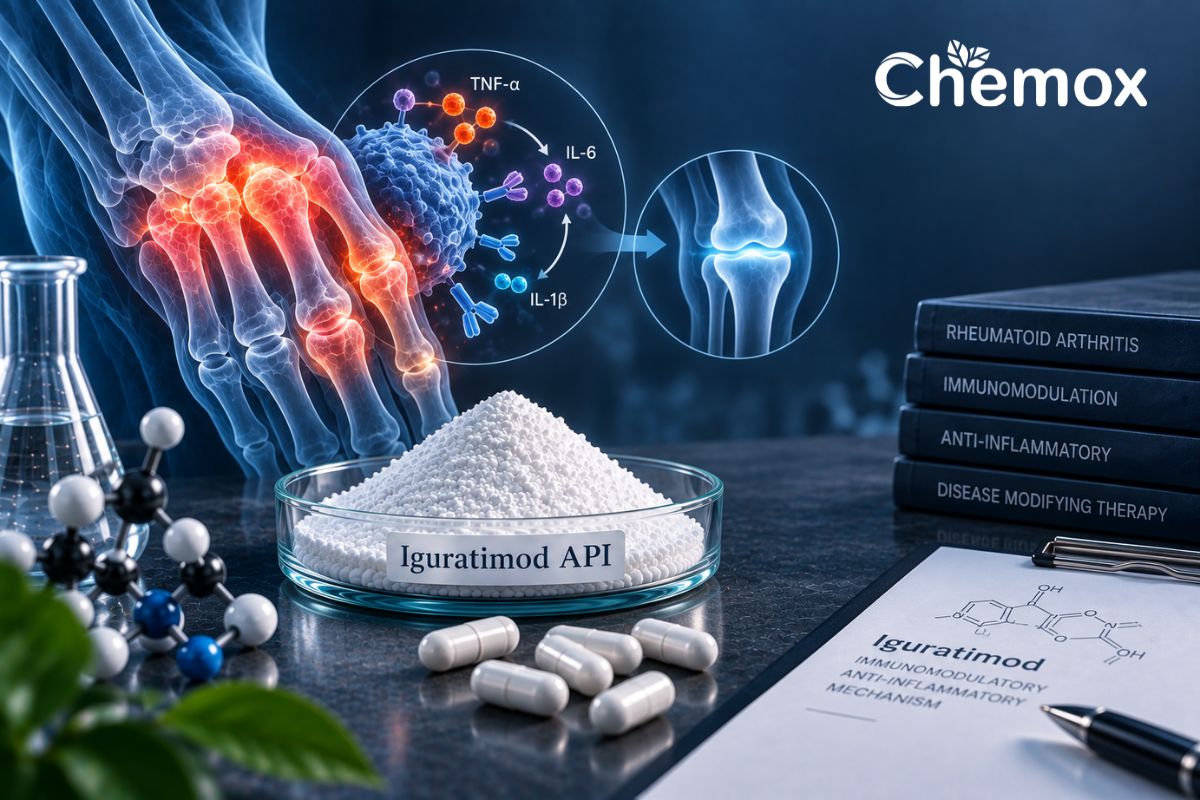
Iguratimod (CAS 123663-49-0) is a conventional synthetic disease-modifying anti-rheumatic drug (csDMARD) that works through multiple, overlapping mechanisms rather than targeting a single inflammatory pathway. It suppresses key pro-inflammatory cytokines — including TNF-alpha, IL-1beta, IL-6, IL-8, and IL-17 — largely by inhibiting NF-kB activation, a central regulator of inflammatory gene expression. Beyond its anti-inflammatory action, Iguratimod also modulates B and T cell function, reduces immunoglobulin production, and helps prevent bone resorption by inhibiting osteoclast differentiation — giving it a bone-protective dimension that distinguishes it from some other conventional DMARDs.
Where Iguratimod Fits in RA Treatment Strategy
Iguratimod has shown particular value as an add-on therapy for RA patients with an inadequate response to methotrexate alone, and evidence also supports its use in patients who haven’t responded sufficiently to biologic DMARDs. This positions it as a meaningful option within combination treatment strategies rather than a standalone first-line therapy — a distinction formulators should keep in mind when thinking about how a Iguratimod-based product fits into a broader RA treatment portfolio.
The Market Context Formulators Should Know
The global Iguratimod market has been on a steady growth trajectory, moving from roughly $120 million in 2024 toward an estimated $220 million by 2034, reflecting sustained demand growth in the rheumatoid arthritis treatment space. China has emerged as the fastest-growing market, driven by its substantial RA patient population and a more streamlined regulatory approval pathway for generic entrants, while Japan — where the molecule was originally developed by Toyama Chemical — remains a dominant market by consumption and manufacturing presence.
Dosage Form and Typical Dosing
Iguratimod is commonly formulated as an oral tablet, typically dosed at 25mg twice daily as part of a combination treatment regimen. This relatively simple, well-established oral solid dosage form makes it a formulation category most generic manufacturers are already well-equipped to produce, with the sourcing and documentation side of the API being the more differentiating factor between suppliers.
Documentation Considerations Across Markets
Iguratimod is registered and manufactured to varying regulatory documentation standards depending on the target market — including formats like USDMF, European DMF/CEP, Japan’s PMDA requirements, and other country-specific documentation frameworks. Given how much this documentation landscape varies by destination market, formulators should confirm directly with their supplier which specific documentation format is available and appropriate for their target registration, rather than assuming a single generic “GMP certified” claim covers what a specific market’s dossier requires.
What to Look for in an Iguratimod API Manufacturer
- Purity and impurity profile — request current HPLC assay data and related-substances documentation.
- Documentation matched to your target market — confirm which specific regulatory documentation format (USDMF, CEP, or another) the manufacturer can support for your registration.
- WHO-GMP certification — verify the certificate applies to the specific facility producing your material.
- Consistent supply capability — confirm current MOQ and lead times, since specialty API production planning can differ from higher-volume generics.
- Facility transparency — a genuine manufacturer can confirm their production site and is generally open to a facility audit or virtual walkthrough.
Iguratimod API for RA Formulations at Chemox Pharma
Chemox Pharma manufactures Iguratimod API at our WHO-GMP certified facility in Dahej, Gujarat. Our team can confirm current documentation support, MOQ, and lead times directly based on your specific target market and formulation requirements.
Request a Quote or Sample
If you’re formulating an Iguratimod-based rheumatoid arthritis product and need API backed by real documentation, get in touch with Chemox Pharma for a quote and sample evaluation.
FAQs
Q: How does Iguratimod work in rheumatoid arthritis treatment? It suppresses key pro-inflammatory cytokines (TNF-alpha, IL-1beta, IL-6, IL-8, IL-17) primarily through NF-kB inhibition, while also modulating B and T cell function and helping prevent bone resorption by inhibiting osteoclast differentiation.
Q: Is Iguratimod typically used alone or in combination with other RA treatments? It’s most commonly used as an add-on therapy alongside methotrexate for patients with an inadequate response to methotrexate monotherapy, and has also shown value for patients who haven’t responded sufficiently to biologic DMARDs.
Q: What dosage form is Iguratimod typically formulated in? It’s commonly formulated as an oral tablet, typically dosed at 25mg twice daily as part of a combination treatment regimen.
Q: Does Chemox Pharma manufacture Iguratimod API for rheumatoid arthritis formulations? Yes. Chemox Pharma manufactures Iguratimod API at its WHO-GMP certified facility in Dahej, Gujarat, and can confirm documentation support for your specific target market.