
Choosing the wrong API supplier doesn’t just affect quality it can derail an entire product launch, trigger regulatory action, and cost your company years of development investment. A failure in API sourcing such as a supplier failing a GMP audit, an unexpected impurity issue arising late in development, or a delay in Drug Master File submission can render a multi-year, multi-million-dollar development project economically unviable.
This is why knowing how to qualify API supplier India is one of the most critical competencies a global pharmaceutical procurement or regulatory affairs team can develop. India is the world’s largest supplier of generic APIs, exporting to over 191 countries and holding more USFDA-approved manufacturing facilities than any country outside the United States. But not every Indian API manufacturer is equal and a structured, rigorous qualification process is the only reliable way to separate the best from the rest.
This step-by-step guide covers everything global buyers need to know: from initial screening to ongoing supplier monitoring complete with a regulatory checklist you can apply immediately.
Why Supplier Qualification Is a Regulatory Obligation — Not Just Good Practice
Before diving into the steps, it is important to understand that API supplier qualification is not optional. Regulators including the USFDA, EMA, and WHO view supplier qualification failures as direct GMP compliance risks. Inspectors assess supply continuity, supplier oversight, and qualification documentation as part of quality system maturity — not as a separate operational topic. Single-source API dependencies and weak supplier oversight have been linked to broader quality system gaps during inspections, leading to warning letters and import alerts against the buyer, not just the supplier.
Procurement decisions made on price alone without a documented qualification framework expose your organization to regulatory liability across every market your finished product enters. A structured approach to qualifying Indian API suppliers protects your regulatory submissions, your product launches, and your patients.
Step 1: Define Your API Specifications and Market Requirements
The qualification process begins before you contact a single supplier. Your regulatory and quality teams must first define:
- API specifications: Assay range, purity thresholds, impurity limits (ICH Q3A compliant), residual solvents (ICH Q3C), particle size distribution, polymorphic form, and pharmacopoeial compliance (USP, BP, EP, or IP)
- Target market regulatory requirements: USFDA (US DMF required), EU (CEP or ASMF + Written Confirmation), WHO-GMP (for emerging markets), or multi-market
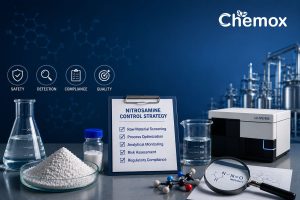
- Nitrosamine risk classification: Based on the API’s molecular structure secondary, tertiary, or quaternary amine functional groups are considered at-risk and require a documented nitrosamine risk assessment per FDA guidance and ICH M7
- Volume requirements: Clinical trial quantities vs. commercial scale this determines minimum manufacturing capacity thresholds
Documenting these requirements upfront creates an objective qualification scorecard against which every potential supplier is evaluated equally.
Step 2: Initial Supplier Identification and Pre-Screening
With your specifications defined, the next step is identifying candidate Indian API manufacturers and conducting a pre-screening assessment. Reliable identification sources include:
- USFDA Drug Establishment Registration database — verify active registrations and check for import alert history
- EudraGMDP database (EMA) — confirm current EU-GMP certification status
- CDSCO portal — verify WHO-GMP certification issued by India’s national regulatory authority
- EDQM database — check for active Certificates of Suitability (CEP) for the specific API
Pre-screening red flags to eliminate candidates early include: lapsed or suspended GMP certifications, active FDA import alerts, warning letters issued within the past three years, and inability to produce a current Certificate of Analysis conforming to the relevant pharmacopoeia.
A well-prepared Indian API supplier will proactively share their GMP certificate, DMF reference number, and a sample Certificate of Analysis without hesitation at this stage. Reluctance to share basic documentation is itself a qualification failure.
Step 3: Request and Review the Technical Documentation Package
Shortlisted suppliers should be asked to provide a comprehensive technical documentation package. The quality, completeness, and organization of this documentation is a direct indicator of the supplier’s regulatory competence. A poorly prepared DMF or incomplete data package is a significant red flag, suggesting the supplier may not be prepared for the rigors of a major regulatory submission.
The technical documentation package should include:
- Certificate of Analysis (CoA) — conforming to USP/BP/EP specifications with all required parameters tested
- Drug Master File (DMF) — for US-bound APIs; review the open/applicant’s part for specifications, impurity profiles, and manufacturing process summary
- Stability data — ICH Q1A compliant, demonstrating API stability under long-term and accelerated conditions appropriate for your target market climate zone
- Impurity profile report — identified and unidentified impurities quantified per ICH Q3A thresholds
- Nitrosamine risk assessment — a documented risk evaluation of the synthesis route, reagents, and solvents for potential nitrosamine formation, with confirmatory analytical data using GC-MS/MS or LC-MS/MS
- Residual solvent analysis — per ICH Q3C, with validated analytical methods
- Process validation summary — demonstrating batch-to-batch consistency across commercial-scale batches
- Manufacturing site details — location, production capacity, batch sizes, and regulatory inspection history
Step 4: Conduct a GMP Audit — On-Site or Remote
Documentation review is necessary but not sufficient. A GMP audit either on-site at the Indian manufacturing facility or conducted remotely using a structured virtual audit protocol is essential to verify that the supplier’s actual practices match their documented procedures.
Companies must qualify suppliers through risk-based GMP audits and documented performance reviews. These controls ensure material quality, regulatory compliance, and inspection readiness across the supply chain.
Key areas to assess during a GMP audit of an Indian API manufacturer:
- Facility design and contamination control: Segregation of production areas, cleanroom standards, HVAC qualification, and cross-contamination prevention systems
- Data integrity systems: Electronic batch record systems (EBMS) with 21 CFR Part 11-compliant audit trails; no shared logins, no manual override capabilities without documented justification
- Laboratory systems: HPLC, GC-MS, Karl Fischer titration, and other analytical instruments fully qualified, calibrated, and maintained; raw data retention policies
- CAPA system: Evidence of a functioning Corrective and Preventive Action system with closed-loop tracking of audit observations, deviations, and OOS investigations
- Change control: Documented processes for managing changes to raw material sources, synthesis routes, equipment, and testing methods — including regulatory notification requirements
- Training records: Personnel training documented and current for all roles in production, QC, and QA
Audit findings should be documented in a formal audit report, with a clear CAPA response timeline requested from the supplier for any observations raised.
Step 5: Sample Testing and Independent Analytical Verification
Before any commercial purchase order is issued, obtain representative samples ideally from at least two or three consecutive commercial-scale batches and conduct independent analytical verification at your own QC laboratory or a qualified third-party contract laboratory.
Independent testing should include:
- Identity confirmation (IR, UV)
- Assay and purity (HPLC) against pharmacopoeial specification
- Impurity profiling — compare against supplier’s CoA; any unexplained discrepancies are a disqualifying finding
- Nitrosamine confirmatory testing — using validated GC-MS/MS or LC-MS/MS methods capable of detecting at parts-per-billion levels
- Residual solvents (GC headspace)
- Polymorphic form confirmation (XRPD or DSC) — critical for APIs with bioavailability-impacting polymorphism
- Microbial limits and endotoxin testing where applicable
- Particle size distribution — particularly relevant for APIs used in dry powder inhalation or poorly soluble drug formulations
Independent analytical verification that matches the supplier’s CoA data — within established acceptance criteria — is a green light to proceed. Unexplained discrepancies require investigation before qualification can be completed.
Step 6: Assess Supply Chain Capacity and Business Continuity
Regulatory and quality compliance is only part of the qualification picture. Global buyers must also assess whether the Indian supplier can reliably meet commercial volume requirements today and as your business scales.
Key supply chain qualification criteria:
- Manufacturing capacity: Can the supplier fulfill your projected annual volume requirements with adequate headroom for demand fluctuations?
- Raw material sourcing: Are Key Starting Materials (KSMs) sourced from qualified, audited suppliers? Are multiple KSM sources qualified to prevent single-source dependency?
- Lead times: What are standard lead times from purchase order to delivery? Are these contractually committed?
- Inventory management: Does the supplier maintain safety stock of the API or critical intermediates?
- Business continuity planning: Is there a documented Business Continuity Plan (BCP) covering scenarios such as natural disasters, regulatory site actions, or utility failures?
- Financial stability: Is the supplier financially sound enough to sustain long-term supply commitments? Request audited financials or references from existing global customers
Step 7: Execute a Quality Agreement and Formalize the Relationship
Once a supplier passes technical, regulatory, and supply chain qualification, the relationship must be formalized through a Quality Agreement (QA) a legally binding document that defines the responsibilities of both parties regarding quality, regulatory compliance, and change management.
A well-drafted Quality Agreement for an Indian API supplier should cover:
- Agreed API specifications and pharmacopoeial standards
- Batch release procedures and Certificate of Analysis requirements
- Change notification requirements — particularly for changes that require regulatory filing (route changes, new KSM sources, site changes)
- Audit rights — the buyer’s right to conduct scheduled and for-cause audits of the supplier’s facility
- Deviation and OOS notification timelines
- DMF/CEP maintenance and amendment obligations
- Nitrosamine monitoring and reporting commitments
API Supplier Qualification Checklist — Quick Reference
| Step | Qualification Criteria | Status |
|---|---|---|
| 1 | API specifications & target market defined | ☐ |
| 2 | GMP certifications verified (USFDA/WHO/EU) | ☐ |
| 3 | No active FDA import alerts or warning letters | ☐ |
| 4 | CoA, DMF, stability data reviewed | ☐ |
| 5 | Nitrosamine risk assessment received & reviewed | ☐ |
| 6 | Impurity profile reviewed against ICH Q3A | ☐ |
| 7 | GMP audit completed (on-site or virtual) | ☐ |
| 8 | CAPA system verified as functional | ☐ |
| 9 | Data integrity systems confirmed compliant | ☐ |
| 10 | Independent sample testing completed | ☐ |
| 11 | Supply capacity & lead times confirmed | ☐ |
| 12 | KSM sourcing and supplier audit trail verified | ☐ |
| 13 | Quality Agreement signed | ☐ |
| 14 | Ongoing monitoring plan established | ☐ |
How Chemox Pharma Supports Your Supplier Qualification Process
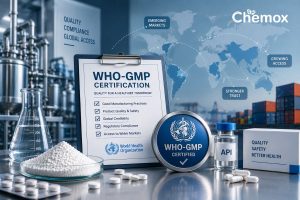
At Chemox Pharma, we understand that qualification is the beginning of a long-term partnership — not a bureaucratic hurdle. Our WHO-GMP certified manufacturing facility, comprehensive regulatory documentation package, and experienced Quality Assurance team are designed to make your qualification process smooth, fast, and successful.
We proactively provide complete technical documentation packages including Certificates of Analysis, stability data, impurity profiles, nitrosamine risk assessments, and DMF reference details for all 18+ molecules in our export-ready API portfolio. Our facility is audit-ready, year-round.
Whether you are sourcing Rosuvastatin, Mirabegron, or any other API from our portfolio, Chemox Pharma is your trusted, compliant, and transparent Indian API partner.
Contact us today to request a qualification documentation package or to schedule a facility audit.